.png)
Constitutional Shield vs. Tariff Sword: SCOTUS Rules Trump Tariffs Unconstitutional—A Turning Point for Global Trade?
When the U.S. Supreme Court issues a "unconstitutional" ruling on the Trump administration’s large-scale tariff policies, it is more than just a legal milestone. It is a massive policy shock that forces global capital markets to re-evaluate the "uncertainty premium." Trade policy has never been about simple tax figures; it is the core variable driving global supply chain structures, USD liquidity paths, corporate profit margins, and inflation transmission mechanisms.
This analysis deconstructs the ruling across three layers: legal implications, international response, and the strategic layout for traders.
I. The Core Significance: Establishing a "Legal Boundary"
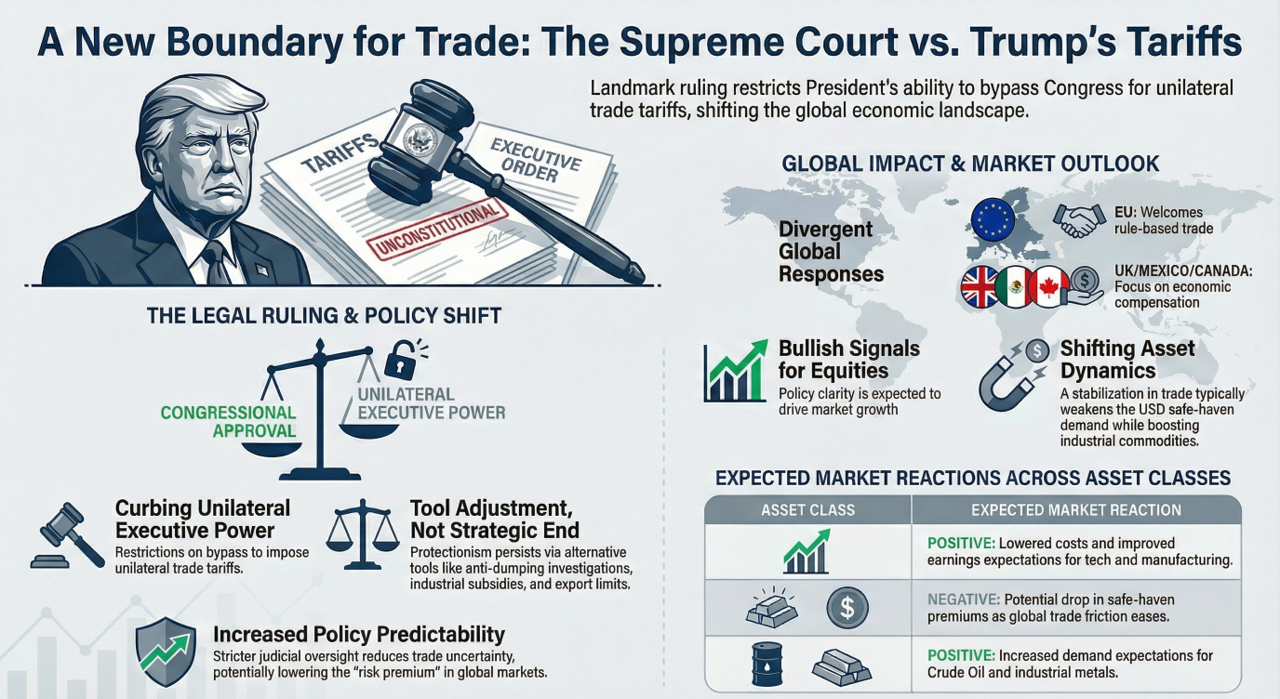
The ruling specifically targets the legality of broad tariffs imposed under the International Emergency Economic Powers Act (IEEPA). By striking these down, the Supreme Court has essentially established a judicial firewall against executive overreach.
The shift means:
Executive Constraint: The President’s power to unilaterally weaponize tariffs is now significantly compressed.
Procedural Transparency: Future trade actions will likely face stricter judicial scrutiny and legislative oversight.
Reduced Volatility: The "policy-by-tweet" era of trade sudden-shocks may be transitioning into a more predictable legal framework.
Trader’s Note: Does this mean the era of trade friction is over? Not necessarily. It means the tools are changing, not the intent.
II. Global Reactions: Reading the Signal Flashes
The response from major trading partners reveals the potential momentum for specific currency pairs:
1. European Union (EUR)
The European Commission is currently analyzing the ruling, with a focus on restoring multilateralism.
Signal: A shift away from "unlimited tariffs" toward predictability.
Market Impact: Reduced hedging costs for Eurozone exporters; potential tailwinds for the EUR.
2. United Kingdom (GBP)
The UK government remains cautious, focusing on practicalities rather than symbolism.
Focus: Can previously paid tariffs be reclaimed? Is commercial compensation viable?
Market Impact: The GBP will react more to tangible fiscal recovery than political headlines.
3. Canada & Mexico (CAD/MXN)
Canada views the ruling as a vindication of its long-standing position, while Mexico is assessing the impact on its 10% general tariff exposure.
Signal: A window of opportunity to repair the North American trade framework.
Market Impact: Strengthening of the CAD and MXN as the "trade war discount" fades.
Forex Correlation Matrix
Asset Relationships • D1
| EUR/USD | GBP/USD | USD/JPY | USD/CHF | AUD/USD | USD/CAD | NZD/USD | EUR/GBP | EUR/JPY | GBP/JPY | AUD/JPY | CAD/JPY | CHF/JPY | |
|---|---|---|---|---|---|---|---|---|---|---|---|---|---|
| EUR/USD | 0.00 | 0.00 | 0.00 | 0.00 | 0.00 | 0.00 | 0.00 | 0.00 | 0.00 | 0.00 | 0.00 | 0.00 | 0.00 |
| GBP/USD | 0.00 | 0.00 | 0.00 | 0.00 | 0.00 | 0.00 | 0.00 | 0.00 | 0.00 | 0.00 | 0.00 | 0.00 | 0.00 |
| USD/JPY | 0.00 | 0.00 | 0.00 | 0.00 | 0.00 | 0.00 | 0.00 | 0.00 | 0.00 | 0.00 | 0.00 | 0.00 | 0.00 |
| USD/CHF | 0.00 | 0.00 | 0.00 | 0.00 | 0.00 | 0.00 | 0.00 | 0.00 | 0.00 | 0.00 | 0.00 | 0.00 | 0.00 |
| AUD/USD | 0.00 | 0.00 | 0.00 | 0.00 | 0.00 | 0.00 | 0.00 | 0.00 | 0.00 | 0.00 | 0.00 | 0.00 | 0.00 |
| USD/CAD | 0.00 | 0.00 | 0.00 | 0.00 | 0.00 | 0.00 | 0.00 | 0.00 | 0.00 | 0.00 | 0.00 | 0.00 | 0.00 |
| NZD/USD | 0.00 | 0.00 | 0.00 | 0.00 | 0.00 | 0.00 | 0.00 | 0.00 | 0.00 | 0.00 | 0.00 | 0.00 | 0.00 |
| EUR/GBP | 0.00 | 0.00 | 0.00 | 0.00 | 0.00 | 0.00 | 0.00 | 0.00 | 0.00 | 0.00 | 0.00 | 0.00 | 0.00 |
| EUR/JPY | 0.00 | 0.00 | 0.00 | 0.00 | 0.00 | 0.00 | 0.00 | 0.00 | 0.00 | 0.00 | 0.00 | 0.00 | 0.00 |
| GBP/JPY | 0.00 | 0.00 | 0.00 | 0.00 | 0.00 | 0.00 | 0.00 | 0.00 | 0.00 | 0.00 | 0.00 | 0.00 | 0.00 |
| AUD/JPY | 0.00 | 0.00 | 0.00 | 0.00 | 0.00 | 0.00 | 0.00 | 0.00 | 0.00 | 0.00 | 0.00 | 0.00 | 0.00 |
| CAD/JPY | 0.00 | 0.00 | 0.00 | 0.00 | 0.00 | 0.00 | 0.00 | 0.00 | 0.00 | 0.00 | 0.00 | 0.00 | 0.00 |
| CHF/JPY | 0.00 | 0.00 | 0.00 | 0.00 | 0.00 | 0.00 | 0.00 | 0.00 | 0.00 | 0.00 | 0.00 | 0.00 | 0.00 |
III. The Reality Check: Has Protectionism Disappeared?
Traders must realize that a legal ruling does not equate to the disappearance of trade friction. The U.S. government still maintains an extensive "arsenal" of alternative tools:
Anti-dumping and Countervailing Duties (AD/CVD)
National Security Clauses (Section 232) re-interpretations
Industrial Subsidies & Tech Export Restrictions
This is a strategic recalibration, not a retreat. Expect protectionism to become more "surgical" rather than "blunt force."
IV. Asset Class Playbook: How to Position
When policy shifts, capital rotates. Here is how to watch the four pillars of the market:
1. The US Dollar (USD)
Scenario: If trade tensions ease, the safe-haven premium on the Greenback will likely evaporate.
Risk: If the ruling leads to fiscal revenue concerns (loss of tariff income), expect heightened volatility in DXY.
2. Equities (US & Global)
Beneficiaries: Tech, automotive, and manufacturing sectors.
Logic: Lower tariff walls lead to reduced input costs and improved EPS (Earnings Per Share) expectations.
3. Commodities
Industrial Metals: Copper and Aluminum may see a demand surge as global trade flow smoothens.
Crude Oil: Positive correlation with global GDP growth expectations following a trade thaw.
4. Gold (XAU)
Outlook: Gold's "uncertainty hedge" may see some profit-taking. However, its long-term trajectory remains tied to USD strength and real interest rates.
Volatility Heatmap by Asset Class
UTC • Current Hour: 16:00
V. The "Policy-to-Market" Transmission Chain
Successful trading of macro events requires a three-step framework:
Announcement: The initial shock/headline.
Expectation Revision: The market digests the legal limits.
Capital Reallocation: Large-scale fund flows move into newly "de-risked" assets.
The Alpha Opportunity: The most significant gains occur when expectations shift, but the broad market has not yet fully priced in the new reality of "Trade Normalization."
How a Policy Shock Transmits Into Prices
A ruling of this kind does not move markets because of the legal text. It moves them because it forces a repricing of the probability distribution over future trade policy. Understanding the transmission chain is more useful than having a view on the ruling itself.
The chain runs through four stages:
Legal event. The ruling changes what the executive branch is permitted to do.
Policy response. The administration either accepts the constraint or seeks alternative legal authority. The speed and credibility of that response determine the market impact far more than the original ruling.
Expectation revision. Corporations revise supply chain, pricing and capital expenditure plans. This is where the real economic effect begins, and it takes quarters, not days.
Price adjustment. Currencies, equities and commodities reprice as the revised expectations are discounted.
Most retail traders trade stage one and are confused when the move reverses. The durable move comes from stage three, and it is visible in corporate guidance, capex announcements and trade flow data long before it is visible in a chart.
Why Uncertainty Reduction Is Not the Same as Risk Reduction
A legal boundary on tariff authority reduces policy variance. It does not necessarily reduce risk — and in some cases it increases it, because the removal of one instrument raises the probability that others get used instead.
This distinction matters for positioning:
Reduced tail risk on the tariff channel. The most extreme scenarios become less probable, which compresses the volatility premium in the most exposed sectors.
Increased attention on substitute authorities. Alternative legal mechanisms have different scope, different timelines and different sector exposure. The policy goal may be unchanged even when the instrument is not.
Refund and litigation overhang. Potential refunds create real cash flow effects for specific importers, and the timing is uncertain — which means the market prices a probability-weighted amount and revises it as courts rule.
The trading conclusion is that "de-risking" trades should be sized for a partial repricing, not a complete resolution. Markets tend to move most on the initial repositioning and then spend months revising the estimate.
Currency Correlations After a Trade Policy Shock
Trade policy shocks are among the few events that materially change the correlation structure between currencies, rather than just their levels. That makes them particularly dangerous for portfolios sized on historical correlations.
What typically changes:
Export-dependent currencies reprice against the dollar on changed terms-of-trade expectations, and their historical correlation with broad risk sentiment weakens temporarily.
Commodity currencies decouple from the commodity itself, because the policy channel affects the terms of trade independently of the underlying price.
Safe-haven relationships invert briefly. During the initial repricing, traditional haven flows can reverse as positioning unwinds rather than as new risk is taken.
Cross-pair correlations converge during the shock, then disperse over following weeks as the specific exposures are sorted out.
The operational implication: re-measure correlations after the event rather than relying on pre-event values, and treat the first two weeks as a period of unstable relationships where aggregate exposure caps matter more than usual.
Correlation Matrix
Analyze the statistical relationship between different assets to avoid over-exposure.
A Framework for Trading Policy Events
Policy shocks share a structure that can be prepared for in advance, regardless of the specific policy.
Separate the ruling from the response. The initial move prices the ruling; the durable move prices the response. They frequently point in different directions.
Identify the transmission channel before the event. For each asset you trade, know which variable actually links it to the policy — terms of trade, input costs, supply chain exposure, or risk premium. If you cannot name the channel, you do not have a thesis.
Expect the first move to overshoot. Positioning unwinds produce larger initial moves than the fundamental repricing justifies. Waiting for the first retracement often improves entry without requiring a directional view.
Size for the repricing, not the headline. The probability revision is usually a fraction of the maximum theoretical impact. Traders who size for the full theoretical move are effectively betting on the most extreme scenario.
Define invalidation in advance. What data would tell you the transmission chain is broken? For trade policy, it is usually corporate guidance and capex, not price.
This framework produces something more valuable than a prediction: a defined set of observable conditions that tell you whether you are right, and how long to stay with the position.
Conclusion: Trading the New Normal
The Supreme Court has set a new legal boundary for global trade, but the reshaping of the global order is far from over. For the modern trader:
Macro events are the source of volatility.
Volatility is the source of opportunity.
The key is not to judge the politics, but to identify the shift in capital flows.
![[FOMC Minutes] Internal Divisions Surface: Rate Cut Pause, or Even a Return to Hikes?](/uploads/f413ed1c-46cb-4dfd-8bba-7cbda5042cec-169---Template---2026-02-19T131415.016.png)
.png)
.png)
More in News
 News2026-09-19
Bitcoin Reclaimed $80,000 on a Rule Nobody Has Read
The CFTC's crypto filing reached the White House with no published text and no deadline. Bitcoin still jumped 5.9% on Friday. Here's what the filing says, what it doesn't, and how to size around it.
 News2026-09-18
Buffett Gave Up the Chair on Friday. Berkshire's Stock Shrugged — and That's the Tradeable Part
Warren Buffett quit the Berkshire chair after 56 years. The stock opened 0.4% lower and went nowhere. What a non-event actually tells CFD traders about sizing, gap risk and the index exposure you didn't choose.
 News2026-09-17
The SEC Cleared a Path to 24/7 Stock Trading. Gap Risk Just Moved.
The SEC's five-year Innovation Exemption lets venues trade tokenized U.S. stocks. The headline is 24/7 trading — but the halt rule buried in the order is what leveraged traders should be reading.