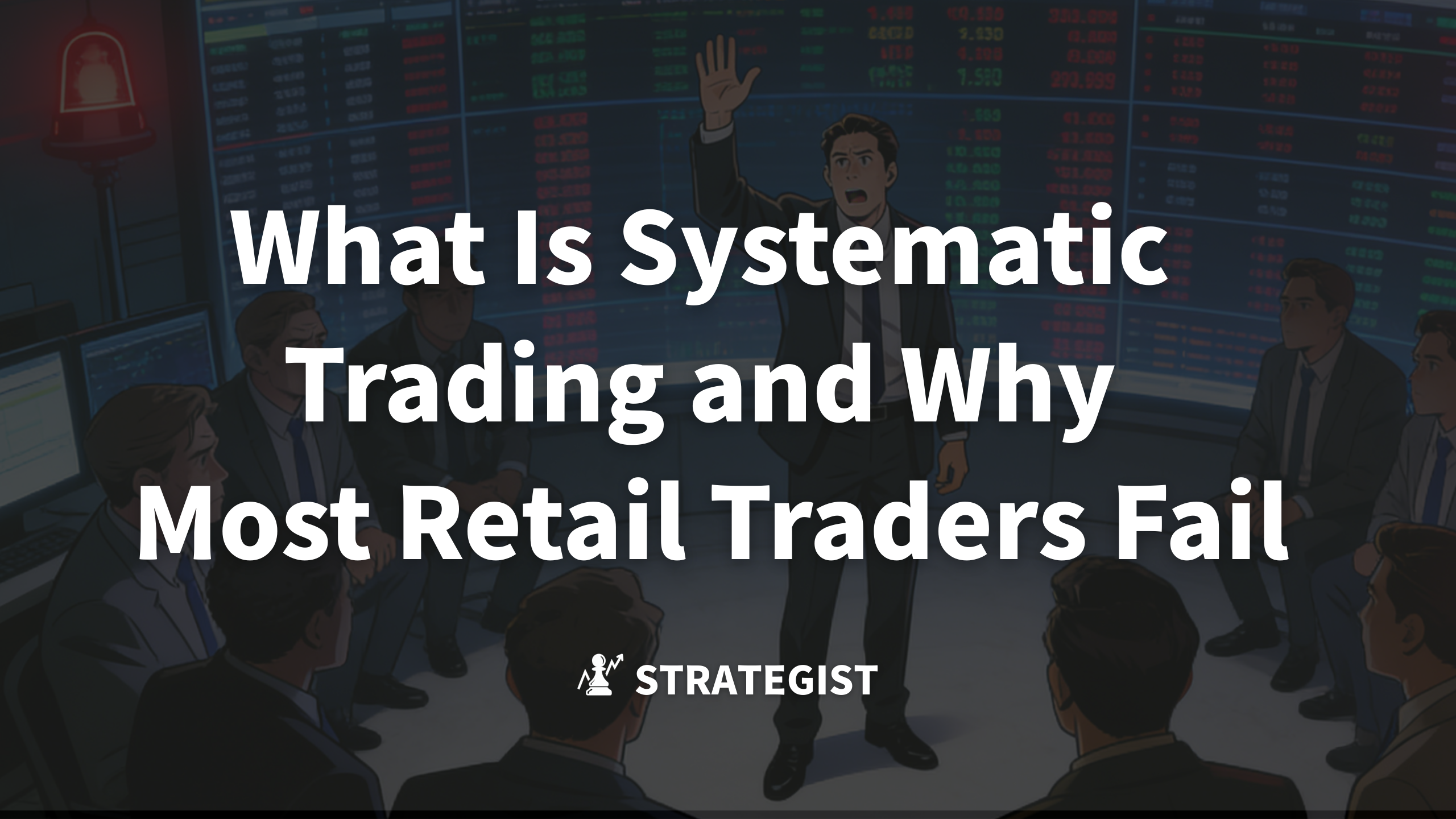
What Is Systematic Trading and Why Most Retail Traders Fail
Introduction
In financial markets, especially in CFD trading, most retail traders approach the market with discretionary decisions, emotional reactions, and inconsistent risk management.
The result is predictable: inconsistent performance, unstable equity curves, and eventual capital depletion.
Systematic trading offers a different path.
It replaces intuition with rules, emotion with structure, and randomness with statistical validation.
This article explains:
What systematic trading really means
How rule-based trading systems work
Why most retail traders fail
How to transition from discretionary trading to structured strategy development
What Is Systematic Trading?
Systematic trading is a rule-based trading methodology where every decision is predefined and testable.
A systematic strategy defines:
Entry conditions
Exit conditions
Position sizing rules
Risk management parameters
Execution logic
There is no discretion once the rules are defined.
In CFD markets, systematic trading often includes:
Moving average crossovers
Breakout models
Mean reversion logic
Volatility filters
Risk-adjusted position sizing
The key principle:
If a rule cannot be defined, it cannot be tested.
If it cannot be tested, it cannot be trusted.
Trend Heatmap
Instant visualization of market momentum across multiple assets and timeframes.
Discretionary Trading vs Systematic Trading
Most retail traders operate in the discretionary column without realizing it.
They believe they have a “strategy,” but what they actually have is a collection of loosely connected ideas.
Why Most Retail Traders Fail
Retail traders typically fail for structural reasons, not intelligence or effort.
1. No Defined Edge
Many traders:
Enter based on “strong candle”
Trade because “price looks extended”
Follow signals from social media
These are not edges.
They are reactions.
A trading edge must be:
Measurable
Backtested
Statistically evaluated
Without validation, performance is random.
Trend Heatmap
Instant visualization of market momentum across multiple assets and timeframes.
2. Poor Position Sizing
Most traders focus on entries.
Professionals focus on:
Risk per trade
Maximum drawdown
Risk-adjusted return
Improper position sizing destroys otherwise profitable systems.
Position sizing often has a larger impact on long-term expectancy than entry precision.
3. Emotional Execution
Fear and greed introduce variance:
Cutting winners early
Moving stop-loss levels
Overtrading after losses
Revenge trading
Systematic trading eliminates this by enforcing predefined rules.
4. No Backtesting or Forward Validation
Without backtesting:
You do not know expected drawdown
You do not know win rate
You do not know risk-to-reward distribution
You do not know statistical expectancy
Trading without testing is equivalent to running a business without financial projections.
The Four Building Blocks of Every Systematic Strategy
A trading system is not an indicator. It is a complete decision framework. If any one of these four blocks is missing, the system is not systematic — it is discretionary trading with extra steps.
Market selection. Which instruments you trade, and under what volatility conditions you stay out entirely.
Entry logic. An unambiguous rule that can be evaluated without interpretation. "Buy when the trend looks strong" is not a rule. "Buy when price closes above the 50-period high and the 20-period ATR is above its 100-period average" is.
Exit logic. Both the stop and the target, defined before entry. Most traders define entries carefully and exits not at all.
Position sizing. How much capital each trade risks, expressed as a fixed percentage or a volatility-adjusted formula.
Notice that none of these blocks is about prediction. A systematic trader does not need to know where the market goes next. They need to know what they will do in every scenario the market can present.
Discretionary vs Systematic: The Real Difference
The distinction is often drawn as "human versus machine," but that is not the point. Many systematic traders execute manually, and many discretionary traders use software. The real difference is reproducibility.
A discretionary trader can look at the same chart twice and take two different trades, because their internal state changed between the two views. A systematic trader produces the same decision from the same inputs every time. That reproducibility is what makes measurement possible — and without measurement, improvement is indistinguishable from luck.
This is also why discretionary traders struggle to diagnose failure. If every trade came from a slightly different process, a losing streak tells you nothing actionable. There is no variable to isolate, no parameter to adjust, no hypothesis to reject.
What an Edge Actually Looks Like
Retail traders often imagine an edge as a signal that wins most of the time. In practice, most robust systems are right less than half the time. An edge is simply a positive expectancy across a large enough sample:
Expectancy = (Win rate × Average win) − (Loss rate × Average loss) − Costs
A system that wins 40% of trades with an average win of 2.5R and an average loss of 1R has an expectancy of roughly 0.4R per trade before costs. That is a genuine, tradeable edge — and it will still produce losing weeks, losing months, and streaks of six or seven consecutive losses.
Understanding this is what separates traders who survive their first drawdown from those who abandon a working system at exactly the wrong moment. You cannot evaluate a probabilistic process by looking at ten outcomes.
How to Transition From Discretionary to Systematic Trading
You do not need to become a programmer. The transition is mostly an exercise in writing things down and then refusing to deviate from what you wrote.
Start by documenting, not optimising. For two weeks, record every trade you take and the reason. The goal is to discover the rule you are actually following, not the one you believe you follow.
Convert your best pattern into a binary rule. Take the single setup you feel most confident about and express it as conditions that are either met or not met. No adjectives, no judgment.
Fix your risk first. Before you test anything, decide the maximum percentage of equity any single trade can lose. This constraint matters more than the entry logic and it is entirely under your control.
Test on data you did not choose. Use a period you have not traded and have not studied. If your rule only works on the window you originally found it in, you have described the past, not discovered an edge.
Forward test small. Run the system at minimum size for at least thirty trades. You are validating two things: the strategy, and your ability to follow it.
Trading Calculators
Precise tools for position sizing, margin requirements, and pip value calculations.
Common Misconceptions About Systematic Trading
"It removes all discretion." It does not. You still choose the market, the timeframe, the risk level, and whether to run the system at all during a given regime. Systematic trading moves discretion to the design stage, where it can be reasoned about calmly, instead of the execution stage, where it operates under stress.
"You need expensive software." A spreadsheet and a data export are enough to validate a simple rule. Tooling helps with throughput, not with correctness. Many traders buy platforms to avoid doing the thinking that would actually improve their results.
"It works until the market changes." Correct — and this is a feature, not a flaw. A systematic framework tells you when it has stopped working, because you know what its normal behaviour looks like. A discretionary framework has no such baseline, so decay is invisible until the account is already damaged.
Conclusion: Structure Is the Only Thing You Control
You cannot control whether the next trade wins. You can control how much it risks, whether the rule was followed, and whether the system was validated before capital was committed. Systematic trading is simply the discipline of putting all your effort into the variables you actually own.
The traders who last are not the ones with the best predictions. They are the ones whose process produces the same decision on a good day and a bad day.
More in Systematic Trading
 Systematic Trading2026-02-12
How to Reduce Drawdowns Without Destroying Expectancy
Cutting drawdowns by tightening stops usually destroys the edge it was meant to protect. A ranked approach to drawdown control — sizing, volatility adjustment, diversification and robustness — that keeps expectancy intact.
 Systematic Trading2026-02-12
How to Evaluate Risk-Adjusted Returns for Your Trading System
Total profit says almost nothing about a trading system. How to evaluate risk-adjusted performance using Sharpe ratio, maximum drawdown, return-to-drawdown, expectancy and return volatility — plus the mistakes that make traders misread their own results.