The Number That Matters Is Average R Times Stop Distance
Stop distance is not edge
Every setup on the board publishes a stop distance: how far the entry sits from the level that invalidates the pattern, expressed as a percentage of price. It is tempting to read a wide stop as a large opportunity — more room, bigger move. That reading is backwards. A wide stop is just a wide stop. Whether the trade pays depends on how often price reaches the target and by how much, and neither of those is encoded in the stop.
The product that matters
Two numbers combine into the quantity a CFD account actually experiences:
expected gross margin = average R × stop distance
Average R is the average multiple of risk a setup has produced historically. The stop distance converts that multiple into a percentage of price. Multiply them and you have the average return the setup is worth per trade, before spread, commission and overnight financing.
The distinction matters because the two inputs move independently. Two setups can share a 1% stop and differ fivefold in average R; they can share an average R of 0.15 and differ fivefold in stop. Only the product tells you what you are actually being paid for the risk you are taking.
Measured on 1,073 live cards
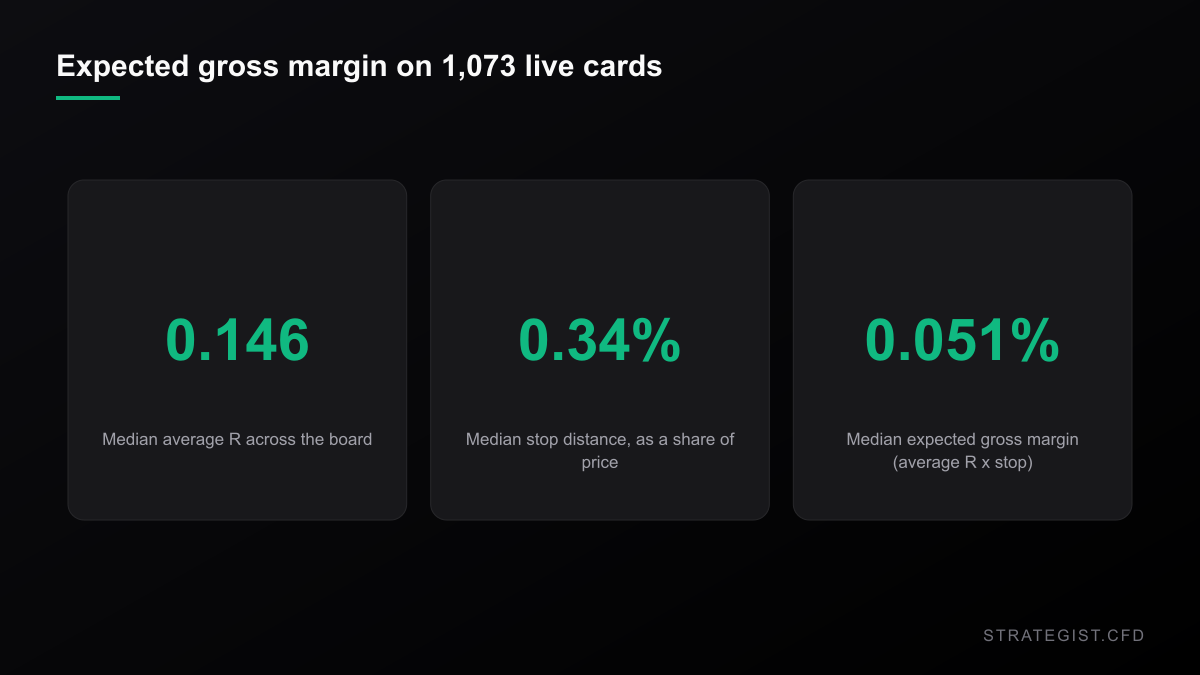
Across the board as it stands this run: median average R is 0.146, median stop distance is 0.34% of price, and the median expected gross margin is 0.051% of price. The first two look respectable on their own. The third is the one that has to meet a broker.
Where the margin lives
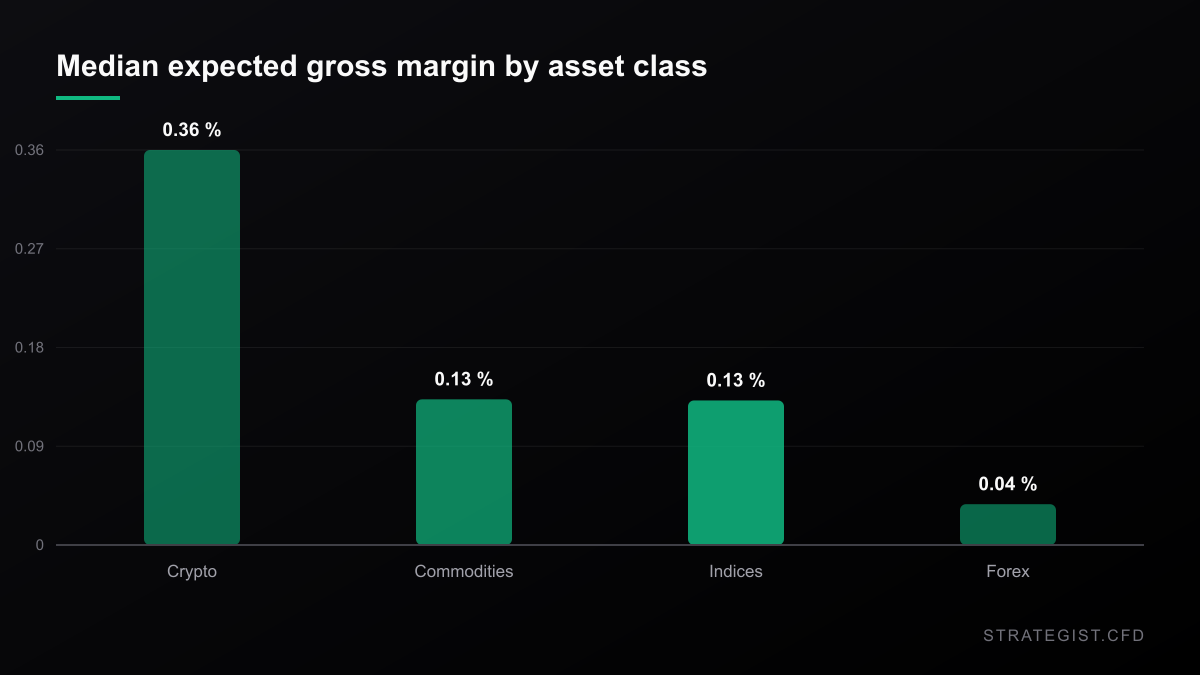
Split the board by asset class and the median margin is nowhere near evenly distributed:
| Asset class | Cards | Share of board | Median expected margin |
|---|---|---|---|
| Crypto | 92 | 8.6% | 0.358% |
| Commodities | 54 | 5.0% | 0.132% |
| Indices | 96 | 8.9% | 0.131% |
| Forex | 831 | 77.4% | 0.037% |
Forex is more than three-quarters of the board and carries the smallest margin by a wide margin — the median crypto card is worth roughly ten times the median currency pair. That is not a statement about which market is easier to forecast. It is a statement about how much price a stop has to cover before the arithmetic works, and how little of that distance a currency pair delivers per unit of risk.
What a round-trip cost does to it
Now impose a cost. Assume a round-trip spread and slippage of 0.05% of price — a mid-range figure for a liquid retail CFD account, and an assumption, not a measured broker quote. At that hurdle, 544 of the 1,073 cards clear it and 529 do not. Raise the hurdle to 0.10% once overnight financing is included and only 359 cards survive. Loosen it to 0.02% and 798 clear.
The point is not the exact number, which moves with your broker and your holding period. The point is that the surviving set is not a random subset of the board: it is concentrated almost entirely in crypto, commodities and indices, because those are the only groups whose median card is worth more than a spread.
What this does not tell you
These are descriptive statistics, not a backtest and not a strategy. The figures are medians computed from the site’s own published signal data on 2026-09-29, in-sample, under one exit rule. Costs are assumptions. A median says nothing about the tail: a group with a small median can still contain cards that pay, and a group with a large median can contain cards that do not. Nothing here is a live account, a funded track record or a verified broker quote.
What the exercise does give you is a screening order. Before asking whether a setup works, ask whether its expected margin clears the cost of collecting it — and remember that the number you need is the product, not either input on its own.