US Core Inflation Hits 4-Year Low: Is the Fed Pivot Finally Here?
US Core Inflation Hits 4-Year Low: Is the Fed Pivot Finally Here?
Following the release of the January US CPI data, market sentiment has shifted decidedly "dovish." We observed a simultaneous drop in Treasury yields, a surge in equity futures, and a significant increase in the implied probability of three rate cuts in 2026.
The core driver? Inflation momentum is officially decelerating. But for systematic traders, the real question remains: Is this enough to confirm a definitive policy pivot? Let’s break down the structural data through the lens of macro strategy.
1. The Surface Data: A Clear Cooling Trend
According to the Bureau of Labor Statistics (BLS):
Tools
Access our suite of professional trading tools and calculators.
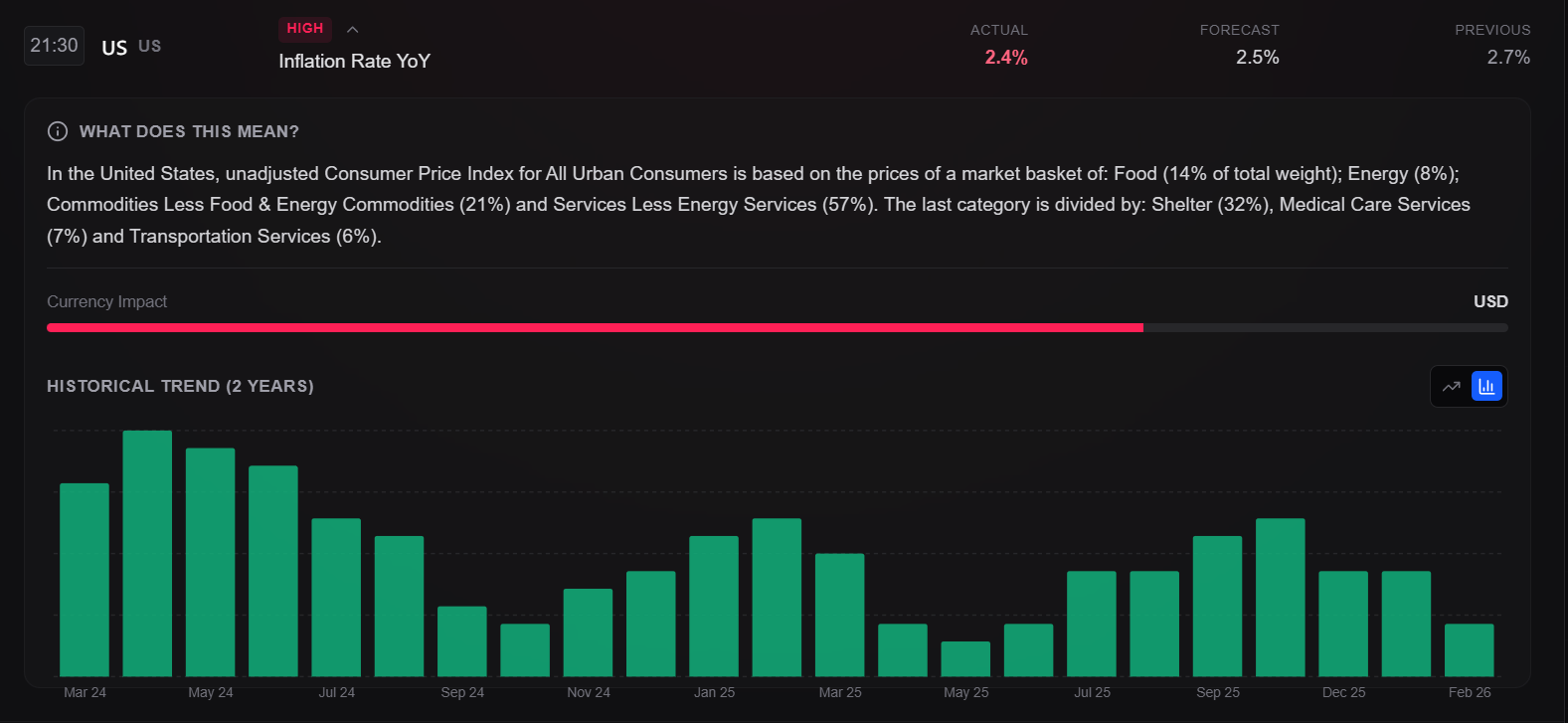
Headline CPI (MoM): +0.2% (Lower than the 0.3% consensus).
Headline CPI (YoY): 2.4% (A nearly 4-year low).
Core CPI (YoY): 2.5% (The lowest level since March 2021).
Key Takeaway: Prices are still rising, but the velocity of the increase is fading. The momentum that fueled the aggressive hiking cycle is dissipating.
2. Structural Analysis: The "Sticky" Service Sector
Despite the annual decline, the Core CPI (MoM) remained at 0.3%. A closer look reveals a divergence between goods and services:
Service Inflation (Excl. Energy): Grew 0.4% MoM, driven by airfares, healthcare, and education.
Goods Inflation: Remains weak, with used car prices and household goods continuing to trend downward.
For the Federal Reserve, this "sticky" service inflation is the final hurdle before committing to a full-scale pivot.
3. The Supercore Signal
Professional traders often ignore the noise and focus on "Supercore Inflation" (Services excluding shelter). While Jan saw a 0.6% MoM spike, the YoY trend remains at multi-year lows. Short-term volatility exists, but the long-term trajectory is undeniably downward.
4. Why the Market is Betting on 3 Rate Cuts
The market logic is straightforward:
Lower Inflation → Reduced Fed Tightening Pressure → Policy Easing Space.
With the current target range at 3.50%–3.75%, continued disinflation gives the Fed ample room to cut rates 2–3 times this year to prevent an over-tightening of the real economy.
Economic Calendar
Track high-impact global events with real-time updates and historical volatility analysis.
5. Macro Scenario Mapping
As a strategist, you must prepare for three potential paths:
Scenario | Inflation Outcome | Fed Action | Asset Impact |
Goldilocks | Hits 2% Target | 3 Cuts in 2026 | Bullish Equities/Gold; Bearish USD |
Stagflationary Lite | Ranges 2.4%-2.6% | Cuts Delayed | Neutral Equities; Bullish USD |
Rebound | Tariffs/Currency shock | No Cuts | Bearish Gold; Strong USD |
6. Trading Implications: Volatility is the Opportunity
The current "split signals" between a strong labor market and cooling inflation create a tug-of-war in policy.
Strong Jobs: No rush to cut.
Falling CPI: Space to cut.
This friction leads to increased volatility, which for systematic traders, represents the primary source of alpha. If the 3-cut consensus holds, we expect Gold to enter a structural bull cycle as real yields decline, while the USD may face long-term overhead resistance.
How to Read a CPI Print Without Overreacting
CPI day is where most discretionary macro traders lose money, because the headline number is the least informative part of the release. A structured read separates what is already priced from what is genuinely new.
Work in this order:
Headline versus expectations, not versus last month. Markets move on the surprise component. A 2.4% year-over-year print is bullish or bearish entirely depending on what was consensus.
Core versus headline divergence. Headline includes food and energy, which are volatile and largely outside the Fed's control. Core is the policy-relevant series. When headline falls and core does not, the move is often a false signal.
The three-month annualised rate. Year-over-year figures carry eleven months of stale data. Annualising the last three monthly changes gives a far more current read on momentum, and it is usually where the real story is visible first.
Components that matter for policy. Shelter, services ex-housing, and goods. Each has a different persistence profile.
What the rates market does next. The FX and equity reaction is driven by the change in the expected policy path, not by the inflation number itself.
That last step is the one retail traders skip. A "good" CPI print can produce a dollar rally if the rates market was positioned for something even more dovish. Trade the repricing, not the headline.
Why Services Inflation Decides the Policy Path
Goods inflation is largely a supply-chain phenomenon and tends to normalise on its own. Services inflation is different: it is driven by wages, which are sticky, and it constitutes the majority of the core basket. This is why the Fed focuses on it and why a single soft goods print does not constitute a pivot.
The mechanism is straightforward. Services prices reflect labour costs, labour costs adjust slowly, and wage growth responds to employment conditions with a lag of several quarters. Even after demand cools, services inflation continues to print firm for months. Expecting it to fall as quickly as goods prices is the most common analytical error in CPI interpretation.
The practical implication for traders: watch the employment cost index and average hourly earnings alongside CPI. If wage growth is still accelerating, a soft CPI print is unlikely to be sustained, and the market's dovish repricing will partially reverse on the next data point.
Scenario Mapping Rather Than Prediction
Systematic macro traders do not forecast a single outcome. They define the scenarios, assign rough probabilities from market pricing, and pre-plan the response to each. For an inflation-driven policy path, the standard set is:
Disinflation confirmed. Core continues lower, services soften, labour market cools gradually. Cuts delivered as priced. Modest USD weakness, supportive for gold and emerging-market currencies, broadly constructive for equities.
Sticky services. Core stalls near current levels. Fewer cuts than priced, and the rates market has to give back its dovish positioning. USD strength, pressure on gold, equity multiples compress.
Re-acceleration. Supply shocks or tariff pass-through push core higher. The hiking tail returns. Sharp USD strength, significant equity drawdown, and — critically — correlations across risk assets converge.
Growth scare. Inflation falls because demand collapses rather than because supply normalises. Cuts arrive faster, but for the wrong reason. Bad for equities and commodities despite the dovish policy response.
The value of this mapping is execution speed. When the print lands you are not deciding what it means; you are matching it to a prepared branch and acting. That removes most of the emotional content from macro trading.
Trading the Release: Structure Over Direction
Whatever the scenario, the release itself imposes a specific microstructure that needs to be respected:
Spreads widen dramatically in the seconds around the print. Stop orders placed at pre-release levels frequently fill far worse than intended.
The first move is often wrong. Initial algorithmic reaction frequently reverses within minutes as human participants and larger flow digest the components.
Volatility expansion is predictable, direction is not. Straddles and breakout systems exploit the former without needing the latter.
Reduce size into the event. A standard practical rule: risk per trade at half your normal level when a high-impact release is scheduled within the holding period.
For systematic traders, the cleanest approach is often a time-based filter: no new entries in the window around the release, existing positions managed by rules set in advance. Trading the print is a separate discipline from trading the trend, and mixing them tends to degrade both.
Economic Calendar
Track high-impact global events with real-time updates and historical volatility analysis.
7. Strategist’s Conclusion: Focus on the Trend, Not the Print
Professional trading isn't about reacting to a single data point; it's about identifying the change in the underlying regime.
Inflation is cooling.
Service stickiness is the "X-factor."
The market always prices in the future before the Fed acts.
Understanding the Interest Rate Path is the master key to navigating the direction of the USD, Gold, and Global Equities.
Stay ahead of the markets with Strategist. Use our AI-driven tools to analyze macro trends and optimize your systematic trading performance.

More in News
 News2026-09-19
Bitcoin Reclaimed $80,000 on a Rule Nobody Has Read
The CFTC's crypto filing reached the White House with no published text and no deadline. Bitcoin still jumped 5.9% on Friday. Here's what the filing says, what it doesn't, and how to size around it.
 News2026-09-18
Buffett Gave Up the Chair on Friday. Berkshire's Stock Shrugged — and That's the Tradeable Part
Warren Buffett quit the Berkshire chair after 56 years. The stock opened 0.4% lower and went nowhere. What a non-event actually tells CFD traders about sizing, gap risk and the index exposure you didn't choose.
 News2026-09-17
The SEC Cleared a Path to 24/7 Stock Trading. Gap Risk Just Moved.
The SEC's five-year Innovation Exemption lets venues trade tokenized U.S. stocks. The headline is 24/7 trading — but the halt rule buried in the order is what leveraged traders should be reading.