Bitcoin Reclaimed $80,000 on a Rule Nobody Has Read
What landed on Thursday has no text
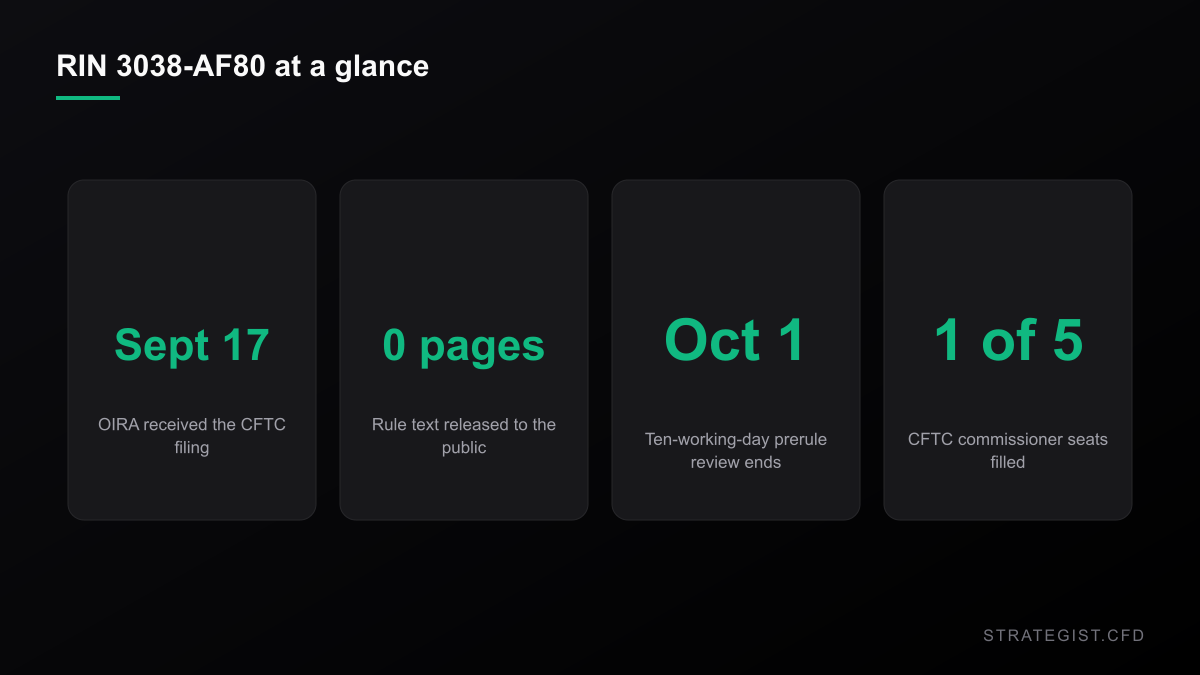
Bitcoin closed Friday at $80,901. It opened the same session at $76,405 — a 5.9% day in an asset whose median daily move over the past eight years is 1.4%. The thing everyone points to as the cause is a filing that contains no rules.
Here's what's actually verifiable. On Thursday, September 17, the Office of Information and Regulatory Affairs logged an action from the CFTC: RIN 3038-AF80, titled "Regulation Crypto Asset Transactions and Regulation Crypto Asset Markets." That's the whole of it. The entry carries no abstract and no text — the CFTC hasn't published a draft. It lists no legal deadline. It's marked not economically significant. And it sits at the "prerule" stage, the EO 12866 category for notices of inquiry, advance notices of proposed rulemaking and other steps that come before a formal proposal.
Two days earlier the Senate refused to take up the CLARITY Act, 49–50 on cloture, eleven votes short of the sixty required, with all forty-nine yes votes coming from Republicans. Polymarket had the bill being signed into law in 2026 at 19.5% on Tuesday morning, before the vote. By Friday it was 7.9%.
The clock nobody is pricing
Prerule is the part that gets lost in the headline. EO 12866 gives OIRA ten working days to review a preliminary action, against ninety calendar days for proposed and final rules. Ten working days from September 17 runs to October 1. The order permits one extension of up to thirty days with the OMB director's written approval, and further extensions at the request of the agency head.
So October 1 is when a review window closes, not when rules show up. After that, a proposed rule still needs a Commission vote, publication in the Federal Register, and a comment period before the CFTC can adopt anything. If you're carrying a position sized for a rule change in October, you're carrying a position sized for something nobody has drafted.
The second detail matters more than the date. Michael Selig is the only sitting commissioner on a five-seat Commission. He was sworn in as the sixteenth chairman on December 22, 2025, and the Supreme Court overturned Humphrey's Executor on July 1, stripping the for-cause removal protection that once shielded CFTC and SEC commissioners. A rule written by a single commissioner at a now politically removable agency is far easier to reverse than legislation would have been. That's a tail risk that doesn't show up in a two-week hold.
What Selig has said beats what the RIN says
Since the filing has no text, the only read on its contents is what the chairman has said out loud. In his first speech as chairman on January 29, Selig said he had directed staff to draft rules "clarifying when leveraged, margined, or financed retail commodity transactions in crypto may be offered off-exchange under an 'actual delivery' exception," to write requirements for designated contract markets offering those transactions, and to explore a new DCM registration category "tailored specifically to retail leveraged, margined, or financed crypto asset trading." On August 20 he tied it directly to the bill: if CLARITY kept stalling, the CFTC would use its existing authorities.
Read it plainly and the work is about leverage, and about where retail is allowed to get it. That isn't trivia if you trade crypto CFDs. None of this binds an offshore broker directly and I'm not going to pretend it does. But it's the clearest signal yet of where a ceiling on retail crypto leverage is being drawn, and ceilings tend to travel.
The same day the filing reached OIRA, the CFTC's Market Participants Division issued Staff Letter No. 26-25: it won't recommend enforcement against providers of passive trading software for failing to register as introducing brokers. Small, technical, and considerably more concrete than the RIN.
Friday's tape, in numbers
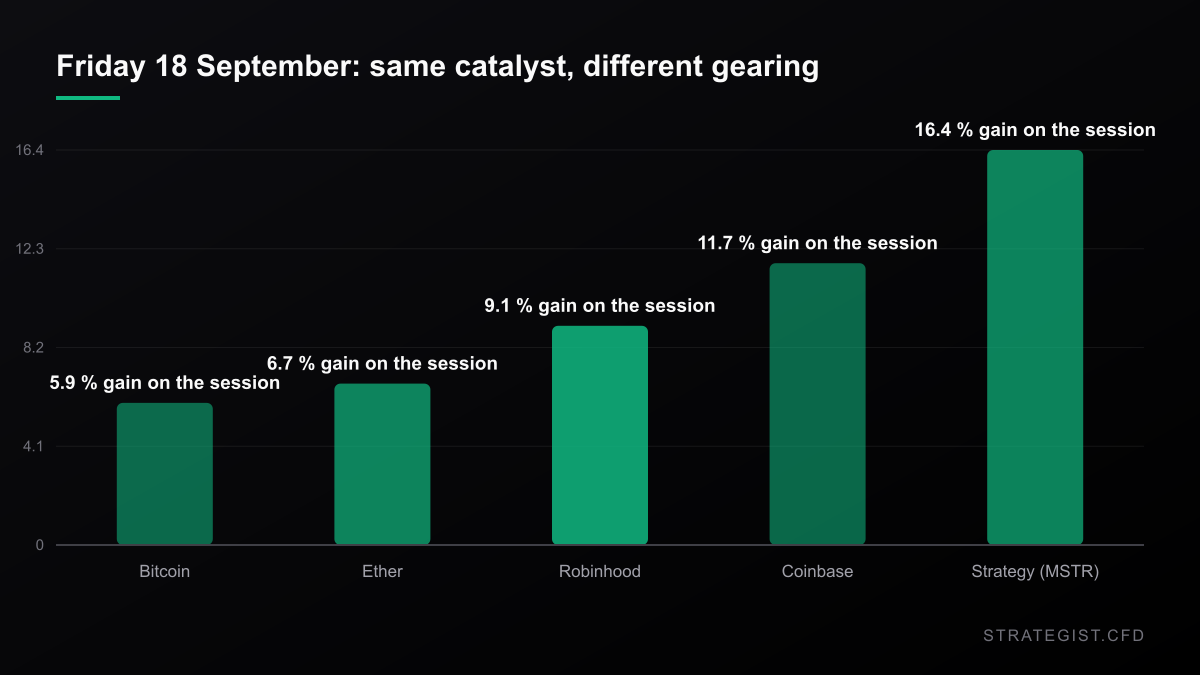
Bitcoin's 5.9% was the smallest move in the group. Ether went from $2,447 to $2,611, up 6.7%. Coinbase closed at $194.25, up 11.7%. Robinhood added 9.1% to $119.82. Strategy (MSTR) took 16.4% to $153.92.
That spread is the whole leverage lesson in one afternoon. One catalyst, four multiples of the same bet. If you were long a bitcoin CFD, a Coinbase CFD and a Strategy CFD, you didn't hold three positions on Friday. You held one position with roughly two to three times the beta you sized for — and correlation only becomes visible when it's working against you.
Then there's the level. Bitcoin's 52-week high is $126,198. At $80,901 it's still 35% below it. Coinbase sits 52% under its 52-week high of $402.16; MSTR is 58% under $365.21. "Back at $80,000" is a recovery inside a drawdown, not a breakout. Anyone calling Friday a breakout is reading a bounce as a trend.
I checked what happens after days like Friday
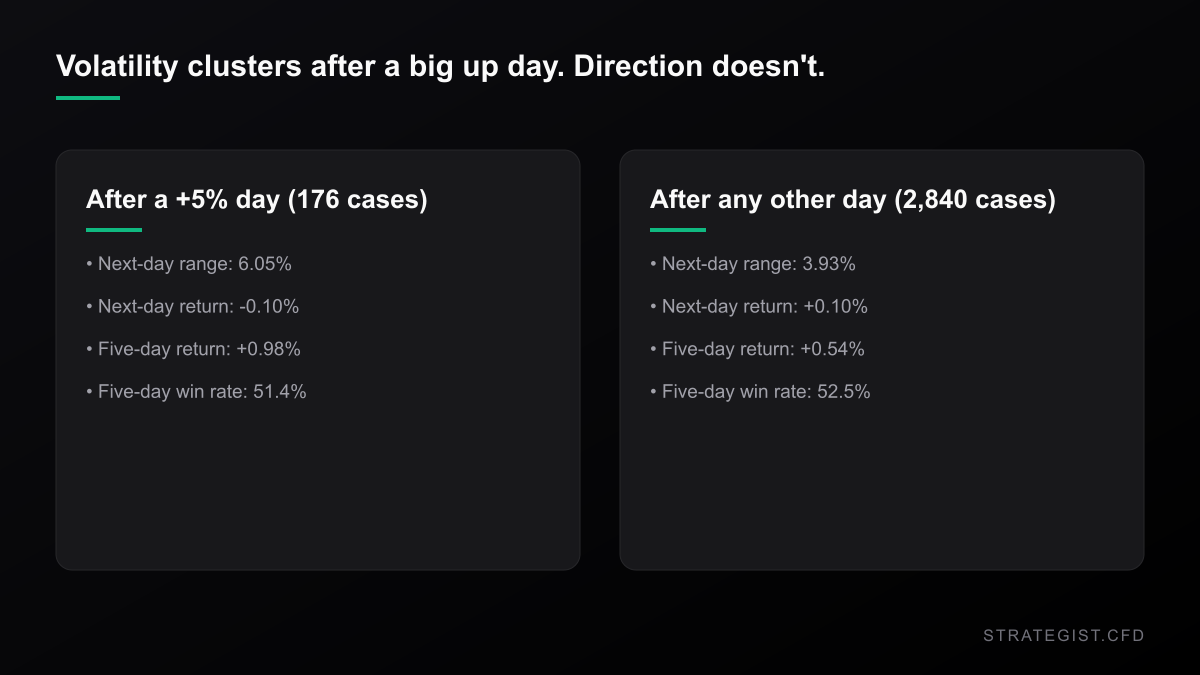
I pulled BTC-USD daily bars from Yahoo Finance, January 1 2018 through September 19 2026 — 3,183 daily returns — and split them into sessions that closed up 5% or more (176 of them, 5.5% of the sample) against everything else. Method stated so you can rerun it; these are averages, not a strategy.
Volatility clusters hard. After a +5% day, the next session's average high-low range was 6.05%, median 5.29%. After every other day, the average range was 3.93% and the median 3.26%. So the session after Friday should be expected to travel about one and a half times as far as a normal one.
Direction doesn't cluster at all. The average next-day return after a +5% day was -0.10%; after everything else it was +0.10%. Five days out, the big-up-day cohort returned +0.98% on average with a 51.4% win rate, against +0.54% and 52.5% for the rest. That gap is noise. If there's a momentum edge in bitcoin following a 6% day, this sample can't find it.
Where the stop goes when the range doubles
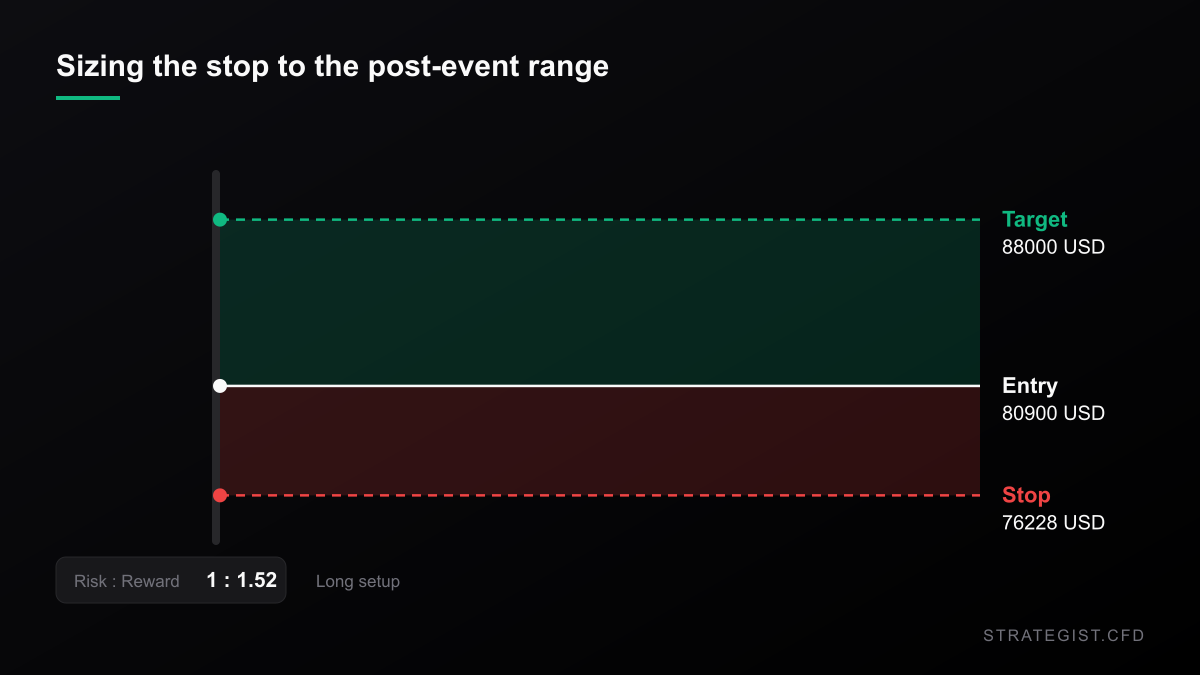
That distinction is the practical part. Most retail stops get placed off the median day, because the median day is what you remember. In this sample the median absolute daily move is 1.41%. Put a stop 2% below Friday's close and you haven't built a risk level, you've built a donation — the expected next-day range is 6%.
An illustrative frame, not a call: entry near Friday's $80,900 close, stop beneath Friday's low at $76,228, first target up at $88,000. That's roughly $4,700 of risk against $7,100 of reward, about 1.5:1 — and the stop sits 5.8% away, which is about one expected daily range rather than a third of one. If risking 5.8% on the position is more than you want, the fix isn't to pull the stop in. It's to cut the size. Half the size at a 6% stop risks the same dollars as full size at a 3% stop, and only one of those survives an ordinary post-event session.
Three ways this read is wrong
First, Friday may have had nothing to do with the CFTC. Tech was up on Friday and the tape was risk-on across the board. A 5.9% day in an asset with a 3.3% daily standard deviation isn't even two sigma. Blaming a regulatory filing is a story told after the fact, and I can't separate the two with the data I have.
Second, the bulls may have the better of it. If the market read the death of CLARITY as making the agency route more likely rather than less — and Polymarket cutting 2026 odds from 19.5% to 7.9% while price rose is consistent with that — then Friday was a clean repricing of a probability, and the real move arrives when text exists. On that reading, fading it because "nothing has happened yet" is exactly backwards.
Third, my averages span eight years that contain at least two completely different bitcoin markets. Spot ETFs, tokenized equities and the SEC's September 17 tokenized-stock order all postdate most of the sample. An average across 176 events tells you what usually happens. It says nothing binding about this week.
The bits you can actually use
- Put October 1 and October 20 on the calendar — OIRA's prerule window closing, and the SEC's Regulation Crypto Assets comment deadline. Treat both as volatility dates, not direction dates.
- Size the stop to the post-event range, about 6%, not to a 1.4% median day. Cutting size is the fix; tightening the stop isn't.
- Count every crypto ticket as one bet. BTC, ETH, COIN, HOOD and MSTR were the same trade on Friday, and the equities ran two to three times the coin.
- Decide the weekend before Friday's close. Bitcoin kept trading on Saturday — around $81,770 — while Coinbase, Robinhood and Strategy were shut. That gap lands Monday whether you planned for it or not.
- With the 10-year back near 5%, overnight financing on a long CFD isn't free. A multi-week hold waiting for a rule pays carry every night.
- You're allowed to trade the volatility without believing the story. The range expansion is measurable. The narrative isn't.
Charts and analysis on this site are for research only and are not investment advice.
More in News
 News2026-09-18
Buffett Gave Up the Chair on Friday. Berkshire's Stock Shrugged — and That's the Tradeable Part
Warren Buffett quit the Berkshire chair after 56 years. The stock opened 0.4% lower and went nowhere. What a non-event actually tells CFD traders about sizing, gap risk and the index exposure you didn't choose.
 News2026-09-17
The SEC Cleared a Path to 24/7 Stock Trading. Gap Risk Just Moved.
The SEC's five-year Innovation Exemption lets venues trade tokenized U.S. stocks. The headline is 24/7 trading — but the halt rule buried in the order is what leveraged traders should be reading.
 News2026-09-16
It Costs a Record $44.8 Million to Ship US Oil to Asia. Spot Prices Fell Anyway.
Freight printed an all-time high on the same 48 hours the Saudi outage that caused it started to unwind. The cost shock is real; the price signal is not what it looks like.