The SEC Cleared a Path to 24/7 Stock Trading. Gap Risk Just Moved.
Robinhood closed up 3.16% on Thursday. No earnings, no guidance, no analyst upgrade behind it. The SEC had published an order letting certain venues trade tokenized versions of U.S. stocks, and the market read it as a green light.
The headlines went with 24/7. That's the wrong thing to stare at — partly because it isn't happening yet, and partly because the order contains a condition that should matter far more to anyone running leverage than trading hours ever will.
What the SEC actually signed on Thursday
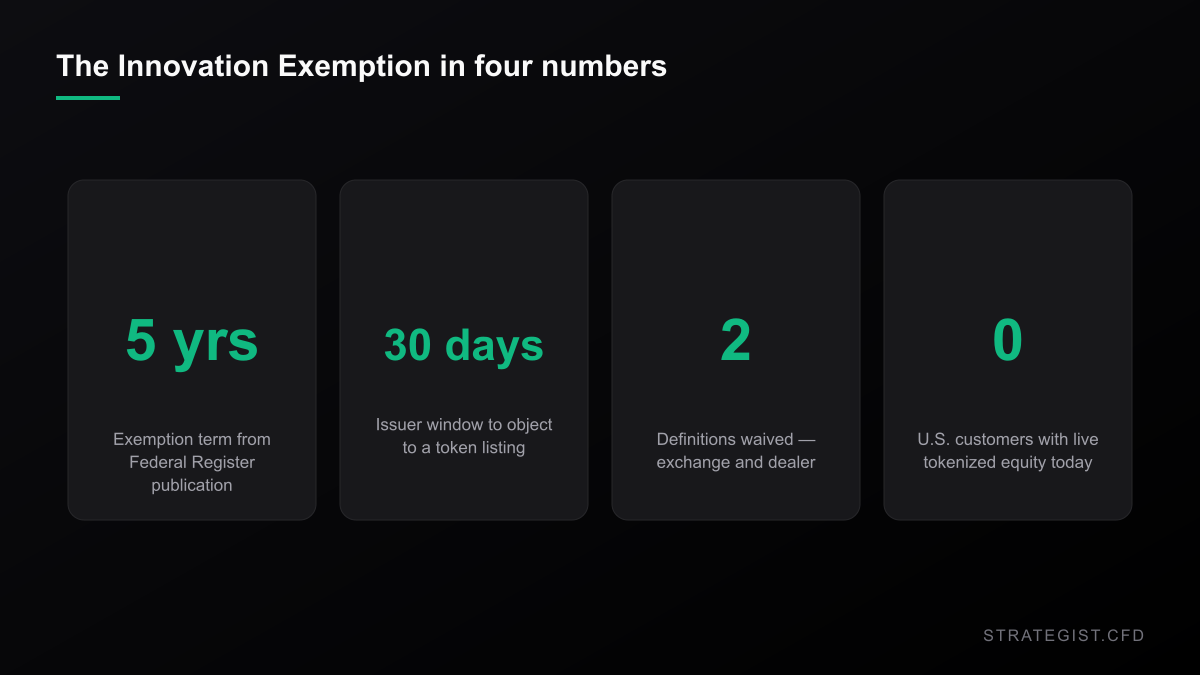
The order creates what the Commission is calling an Innovation Exemption. In plain terms: a venue that wants to trade tokenized versions of NMS stocks — national market system, meaning the main listed U.S. equities — can do it without registering as an exchange, provided it clears a list of conditions. Separate relief covers the liquidity providers who would run the automated market maker pools behind those trades, exempting them from the "dealer" definition. Both sit under Section 36(a)(1) of the Exchange Act, the general exemptive authority Congress gave the agency.
It's effective immediately, and it expires five years after publication in the Federal Register. Chair Paul Atkins was careful to say the Commission isn't treating any of this as the end state. "The Commission is not cementing today's technology as the standard for tomorrow," he said, adding that the interim measure "must be followed by durable rulemaking."
The timing tells you something. The order landed two days after the Clarity Act — crypto's big market-structure bill — failed to advance in the Senate. Atkins has framed this as the SEC building what it can under authority it already has. That cuts both ways: the part of this that needed Congress hasn't happened, and the part that didn't is explicitly temporary.
None of it is a formal rulemaking, either. The order solicits comment on the design, which means the version that exists in 2028 may look nothing like the version published this week.
The halt rule is the part nobody has priced
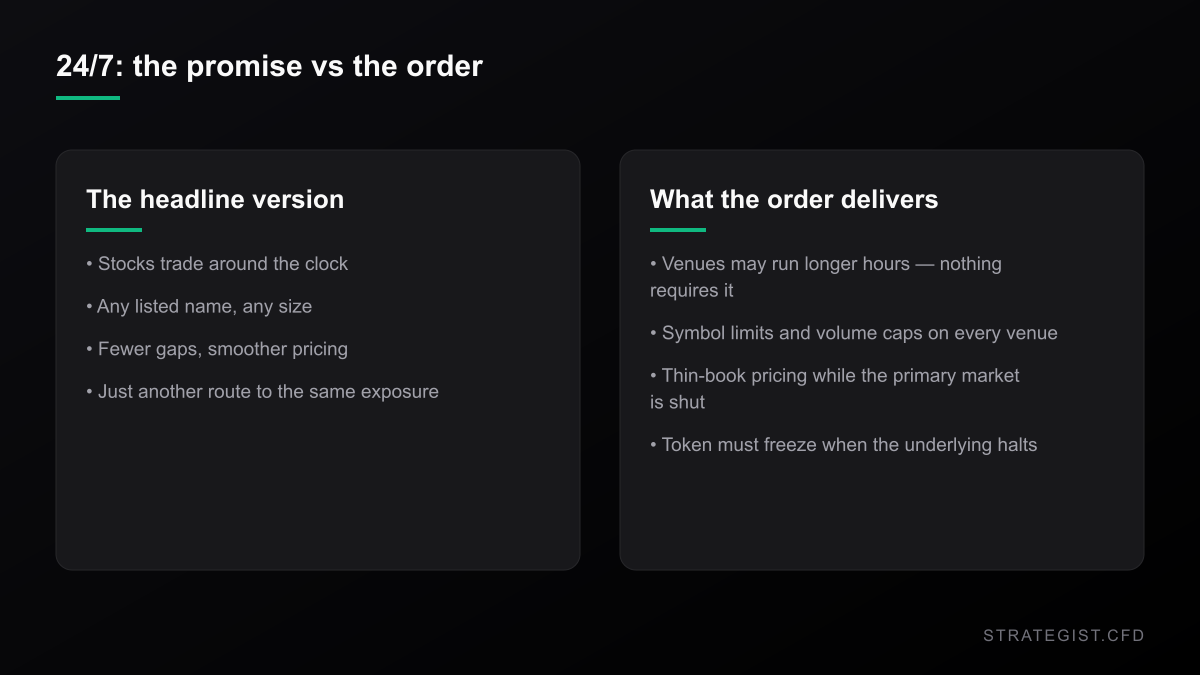
Here's the condition I'd underline twice. A tokenized venue must stop trading a token at the same moment the underlying stock stops trading on its primary listing exchange.
Read that as a trader rather than a lawyer. You're holding a leveraged position in a tokenized name at 2am on a Sunday. News breaks. The primary listing halts the stock at the open pending disclosure. Your token stops trading too — not because you chose to exit, but because the venue is required to freeze it. Meanwhile your margin engine, your overnight financing and whatever stop logic you've got running don't pause. They keep charging and keep calculating against a position you're not allowed to close.
This isn't some remote edge case. Halts around earnings, M&A and regulatory news are routine, and the entire selling point of a round-the-clock venue is that it will be open during the hours when the primary market is shut. That overlap is precisely where the risk sits.
There's a second kind of freeze buried in the order. Before a venue lists a token created by an unaffiliated third party, it has to give the issuer written notice and wait 30 days. If the company objects inside that window, the token doesn't trade. So the set of names you can actually trade isn't determined by demand — it's subject to a veto from the companies themselves. AMC's Adam Aron spent early September arguing publicly with Robinhood's CEO over exactly this point, and Robinhood has since said it will move to 1:1 redemption for the underlying shares plus voting rights.
A token and a CFD are not the same trade
This is where it gets practical, because it's tempting to file tokenized stocks next to CFDs in the same mental drawer as "synthetic exposure." They aren't the same instrument, and the differences land in places that affect your fill.
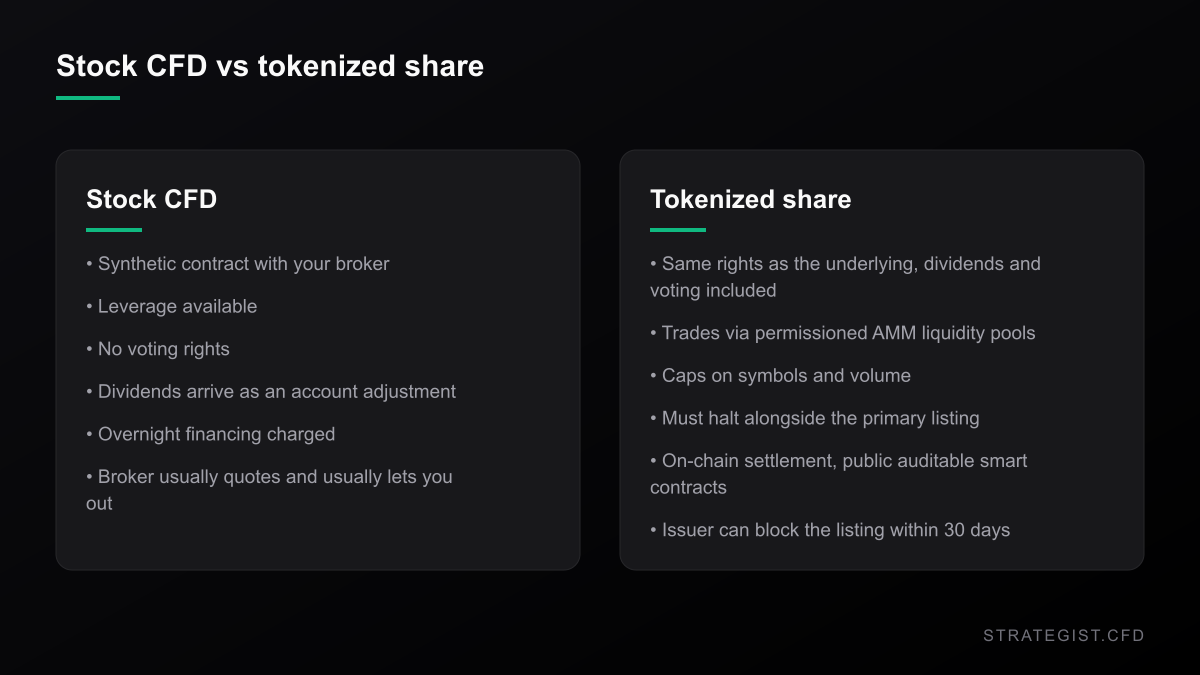
A stock CFD is a contract with your broker. You get price exposure, leverage, and typically a financing charge for holding overnight. You don't get voting rights, and dividends arrive as an account adjustment rather than an actual distribution. What you do get is a counterparty who is quoting you a price and, most of the time, letting you out.
A tokenized share under this order has to carry the same rights and privileges as the underlying — dividends and voting explicitly included. That's written into the conditions, not left to the venue. But it trades through permissioned AMM liquidity pools with symbol limits and volume caps that Commissioner Uyeda described as calibrated by limit-up, limit-down tiers.
So: better legal rights, probably worse fills. If you're putting on a short-term leveraged trade, the voting right is worth approximately nothing to you and the thinner book is worth a great deal — in the wrong direction. Rights are a buy-and-hold feature. Liquidity is a trader feature.
24/7 is a liquidity claim, not a calendar claim
CNBC's own write-up flagged the drawback: longer hours means more time when trading is thin, and thin trading means bigger price swings. I think that undersells it for anyone using leverage.
The standard argument for extended hours is that continuous trading reduces gaps. Instead of one violent Monday open, news gets absorbed gradually as it arrives. Maybe. But a gap is a single, legible risk — you can see it, size for it, and decide whether you want to be exposed to it. What a capped, always-on venue offers instead is a long stretch of thin, jumpy pricing where your stop is visible in a shallow book and a modest order moves the mark. You're trading one tail event for a hundred small ones, and small ones are the kind that quietly wreck a month rather than a single trade.
Credit where it's due: the order demands a decent amount of transparency. Price, size, time, pool address, end-of-day pool size and daily volume all get published at regular intervals. That's genuinely useful and it's exactly the kind of data you want before you size anything into a venue you don't know. Read it before you trust the quote.
Where this could be wrong
I'll be straight about the holes in the above, because there are several.
- This could be a non-event for years. Coinbase, Robinhood, Gemini and Kraken all run tokenized equity offerings offshore. None of them offer it to U.S. customers yet. A five-year conditional exemption with volume caps is not the same thing as deep 24/7 markets in 2027.
- More hours might compress volatility rather than spread it out. If continuous trading lets news get absorbed incrementally, Monday gaps get smaller — and my death-by-a-thousand-cuts framing is simply wrong.
- AMM pools might quote tighter than I expect. I'm assuming thin-book slippage based on how restricted-participation pools usually behave, but the conditions here are unusual and I haven't seen a live quote from a TSV, because none are running.
- The halt risk only bites if you're holding through a halt with leverage. If you're flat overnight and don't carry weekend exposure, most of that section is irrelevant to you.
There's also a version of this where the exemption becomes permanent, volumes grow, and the tokenized venue ends up with better price discovery than the after-hours sessions it replaced. I'd rather be early in sizing that than wrong about it — but I don't have evidence for it yet.
What to actually do with this
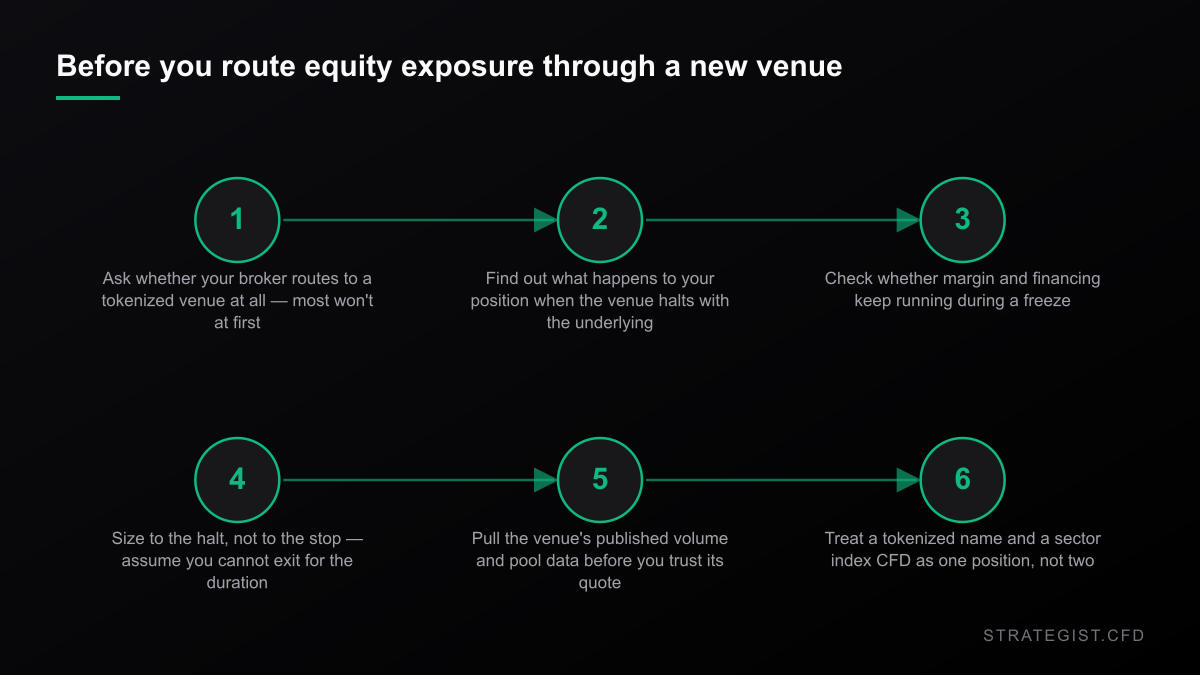
None of the above requires you to hold a view on whether tokenization wins. It requires knowing which venue your order actually lands in, and what happens to your position when that venue freezes.
The practical work is unglamorous. If your broker starts routing equity exposure through a tokenized venue, the questions worth asking are about halt behaviour and margin treatment during a freeze — not about the trading hours. And the sizing rule follows from that: size to the halt, not to the stop. If there's a realistic path where you cannot exit for the duration of a halt, your position size has to survive that, not survive the distance to your stop.
One last thing that's easy to miss. If you're long a tokenized tech name and also long a Nasdaq 100 CFD, you haven't diversified anything. You've doubled a position you were already running, in a vehicle with different halt behaviour and thinner liquidity. Check your correlation before you check your chart.
Charts and analysis on this site are for research only and are not investment advice.
More in News
 News2026-09-19
Bitcoin Reclaimed $80,000 on a Rule Nobody Has Read
The CFTC's crypto filing reached the White House with no published text and no deadline. Bitcoin still jumped 5.9% on Friday. Here's what the filing says, what it doesn't, and how to size around it.
 News2026-09-18
Buffett Gave Up the Chair on Friday. Berkshire's Stock Shrugged — and That's the Tradeable Part
Warren Buffett quit the Berkshire chair after 56 years. The stock opened 0.4% lower and went nowhere. What a non-event actually tells CFD traders about sizing, gap risk and the index exposure you didn't choose.
 News2026-09-16
It Costs a Record $44.8 Million to Ship US Oil to Asia. Spot Prices Fell Anyway.
Freight printed an all-time high on the same 48 hours the Saudi outage that caused it started to unwind. The cost shock is real; the price signal is not what it looks like.