It Costs a Record $44.8 Million to Ship US Oil to Asia. Spot Prices Fell Anyway.
On September 15, Bloomberg reported that it now costs $44.8 million — a record — to ship a cargo of US crude from the Gulf Coast to Asia. On September 16, oil fell. Both things happened, and the gap between them is the most useful trading lesson in the energy market this month.
The number, and what it's actually measuring
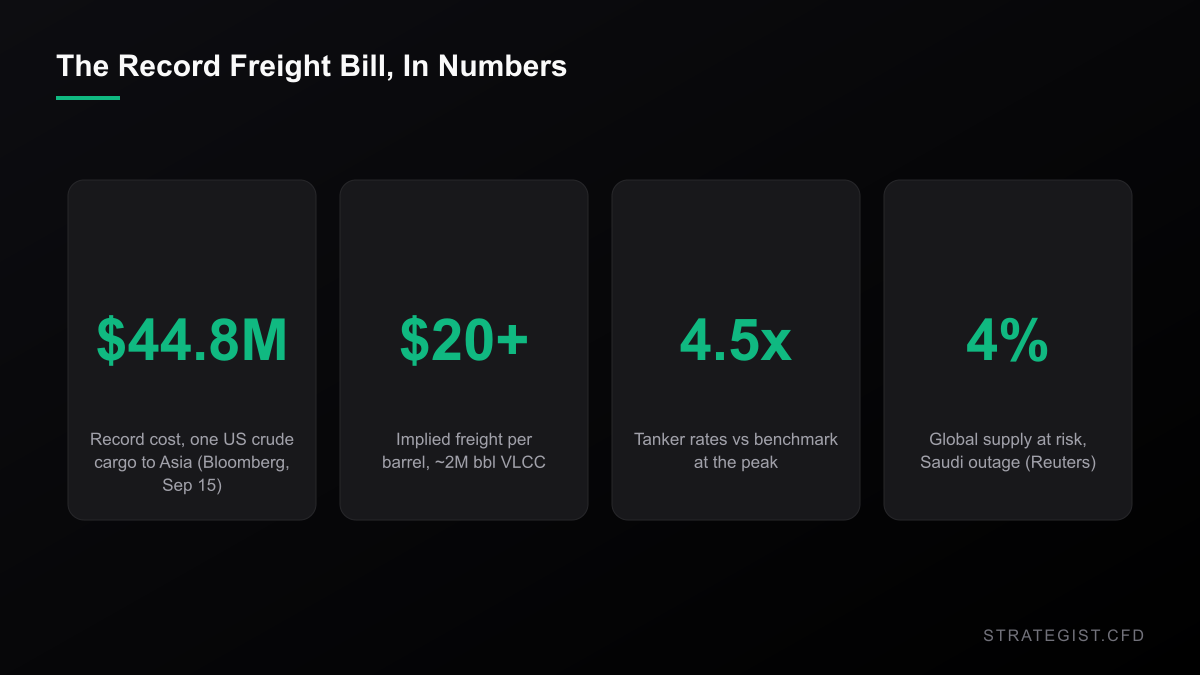
That $44.8 million isn't a futures contract or a notional figure. It's roughly what it costs to charter a very large crude carrier for the run, and it's the highest anyone has paid.
Do the arithmetic and it gets uncomfortable. A VLCC carries around two million barrels. Spread $44.8 million across that and the freight alone lands somewhere north of $20 a barrel — before you've paid a cent for the oil. For a cargo already competing with Middle Eastern barrels on price, that's the entire trade margin, gone.
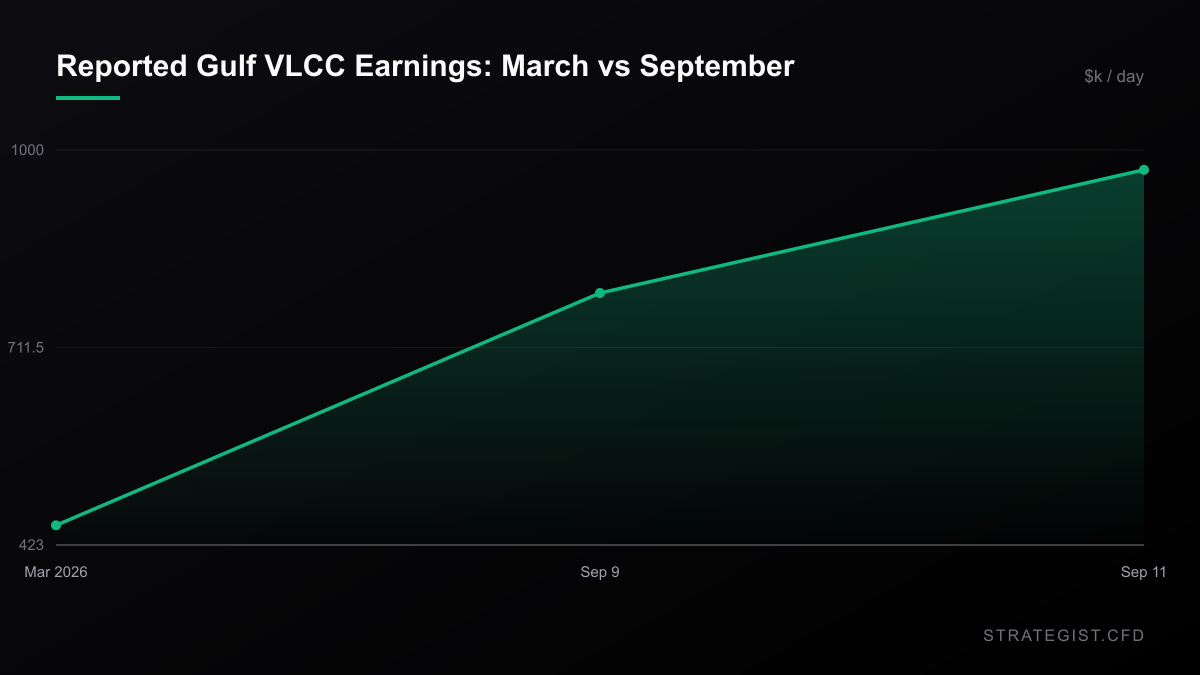
Context sharpens it. Reuters reported on September 11 that tanker rates had hit record highs following attacks on shipping. TradeWinds had Gulf VLCC earnings flirting with $800,000 a day two days before that, and Riviera Maritime reported a fixture above $1 million a day for a Gulf-to-China trip. One trade summary put rates at roughly 4.5 times the benchmark. These aren't incremental moves. Freight had gone vertical.
The record printed after the news
Here's the part that should make you slow down. Freight was already at records on September 11. The drone attack on Saudi Arabia's East-West pipeline landed around September 13–14, and Reuters said the outage threatened about 4% of global oil supply. Brent pushed above $108 with WTI near $102 around September 14. Newsweek reported the line could be down for weeks.
Then the freight record printed on September 15 — and on September 16 oil fell, because the US said the damaged pipeline would restart within days. Reuters had the same session as oil slipping while Saudi Arabia offered more crude via Oman.
So the actual sequence is: physical disruption, freight spikes, spot spikes, freight prints a record, spot falls. The $44.8 million figure wasn't a warning about what's coming. It was a receipt for what had already happened.
The part you can actually trade is the gap, not the barrel
Let's be blunt about the first problem. You cannot buy freight. No retail CFD broker offers VLCC rates. You can buy shipping equities, but that's a levered bet on the same theme with earnings, management and equity beta bolted on — a different trade with a different risk profile.
What the freight number really does is wedge the two crude benchmarks apart. If it costs $20-odd a barrel to get US crude in front of an Asian buyer, US crude has to be that much cheaper at the wellhead to clear. That discount is the Brent-WTI spread, and it is a genuine, tradeable object. Reuters flagged the same mechanism back in March when the WTI discount to Brent hit its widest in 11 years. Around September 14, with Brent above $108 and WTI near $102, you were looking at roughly a $6 gap.
The catch: $6 on a $105 barrel is a small number, and it moves far more slowly than either leg. Which brings us to where most retail attempts go wrong.
Legging a spread on a CFD account costs more than the spread pays
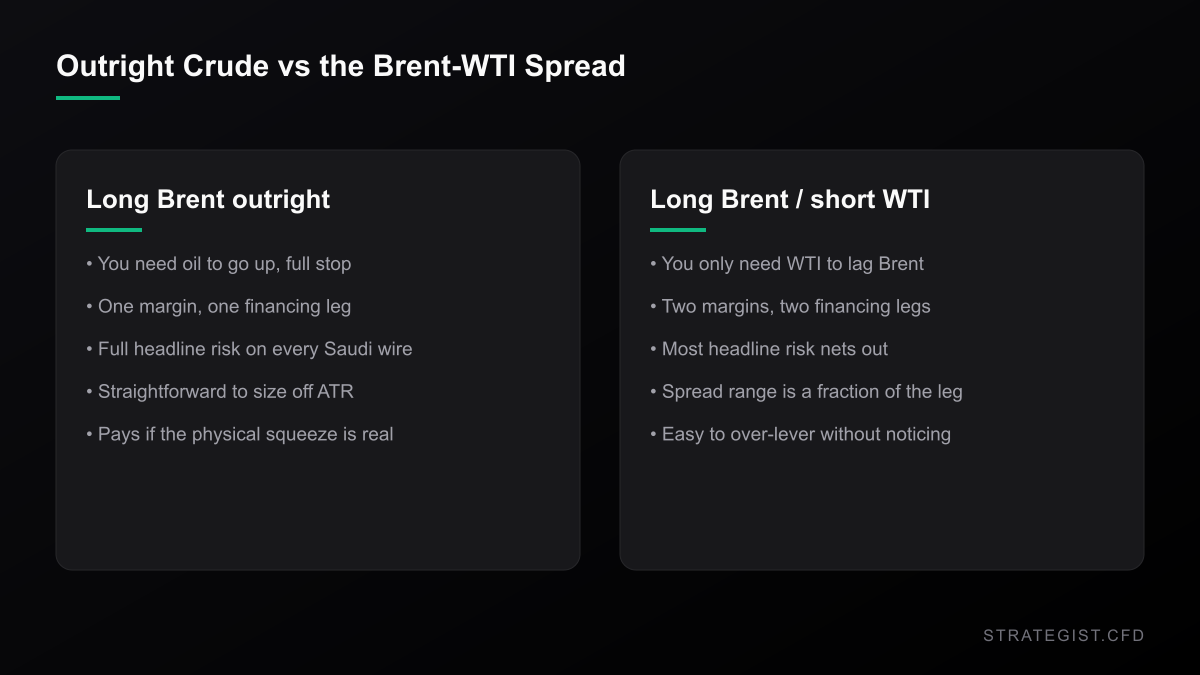
Your broker almost certainly doesn't list "Brent minus WTI" as an instrument. So you build it — long one Brent CFD, short one WTI CFD. Sounds clean. Now count what that actually costs.
- Two margin requirements. Some brokers give a partial offset on correlated pairs. Plenty give you none. Assume the worst until you've checked the instrument spec yourself.
- Two overnight financing charges. Both legs are typically charged, and a freight thesis needs weeks to play out. That's a steady bleed the spread has to outrun before it earns anything.
- Four spreads paid. You cross the bid-ask on the way in on both legs, and again on the way out.
- Basis risk you can't see on a single chart. The two contracts are near-identical right up until they aren't, and the difference between them is precisely the risk you've chosen to take.
Then the sizing trap, which is the one that actually blows accounts up. The spread's daily range is a fraction of either leg's. If you size the position the way you'd size a normal crude trade — off Brent's ATR — the P&L barely moves, so you double it. Now you're carrying twice the notional across two legs with a carry cost, on a thesis that needs three weeks. That's how a correct view still loses money.
Where this view is probably wrong
I'd rather say this out loud than pretend freight is a clean signal. Three ways it breaks.
First, freight rates are violently mean-reverting. The same trade press reporting $1 million-a-day fixtures in September was reporting $423,000 a day back in March. If Hormuz traffic normalises and the pipeline comes back on schedule, rates can hand back a third of the move in a fortnight and take the arb with them.
Second, I might have the direction of the lag backwards. Freight clears at the margin — the last cargo sets the price — so a freight spike can genuinely lead the physical market rather than trail it. If Asian buyers simply stop booking US barrels, the WTI discount widens further and the spread trade works even while spot falls. That's a coherent bull case for the spread and a bear case for the outright, at the same time.
Third, and most likely to bite: the spread you compute from two CFD quotes isn't the spread you get. Your WTI CFD is probably priced off the front-month future with its own roll schedule and its own expiry gap against Brent's. The $6 you see on screen may be $6 plus or minus a roll you don't control. On a thesis this thin, that could be the whole edge.
What to actually do with this
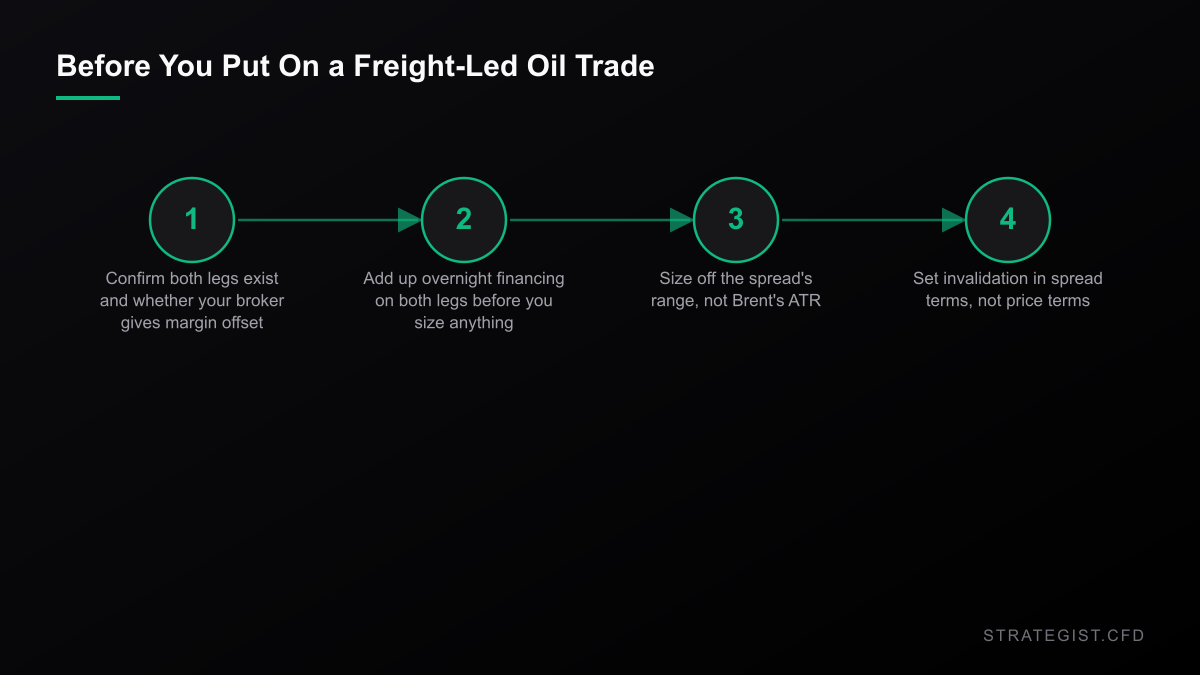
None of the above means "don't trade it." It means trade the right instrument at the right size, and stay honest that a cost shock is not a price forecast.
If you want exposure to the physical squeeze, the outright is still the simplest expression — but notice that the market priced the outage and then started taking it back inside 48 hours. Buying crude because shipping got expensive is buying the cost side after the price side has already moved.
If you want the spread, size it off the spread's own range, not off Brent's. Write your invalidation in spread terms — this thesis is dead if the gap closes to X — rather than in price terms, because you can be right about the gap and still get stopped out by both legs falling together.
And treat the restart headline as an event with no scheduled time. "Within days" is exactly the phrasing that produces a gap. If your stop sits inside the current daily range, it isn't a stop. It's a donation.
Charts and analysis on this site are for research only and are not investment advice.
More in News
 News2026-09-19
Bitcoin Reclaimed $80,000 on a Rule Nobody Has Read
The CFTC's crypto filing reached the White House with no published text and no deadline. Bitcoin still jumped 5.9% on Friday. Here's what the filing says, what it doesn't, and how to size around it.
 News2026-09-18
Buffett Gave Up the Chair on Friday. Berkshire's Stock Shrugged — and That's the Tradeable Part
Warren Buffett quit the Berkshire chair after 56 years. The stock opened 0.4% lower and went nowhere. What a non-event actually tells CFD traders about sizing, gap risk and the index exposure you didn't choose.
 News2026-09-17
The SEC Cleared a Path to 24/7 Stock Trading. Gap Risk Just Moved.
The SEC's five-year Innovation Exemption lets venues trade tokenized U.S. stocks. The headline is 24/7 trading — but the halt rule buried in the order is what leveraged traders should be reading.