Diesel Just Broke $6 a Gallon. The Tradeable Part Is the Gap, Not the Pump.
Diesel just did something it has never done
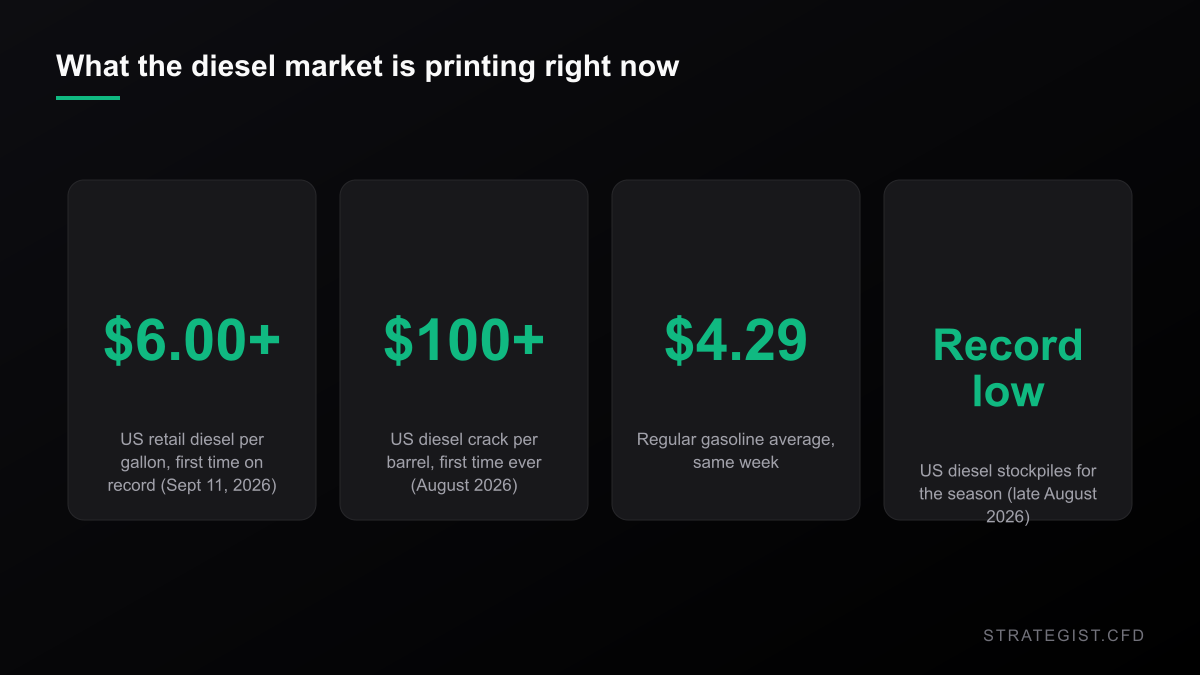
For the first time on record, the national average price of diesel in the United States passed $6 a gallon. It crossed on September 11 and by the weekend it was in CNBC, the AP, CNN and Time. Regular gasoline sat near $4.29 in the same week.
If you run a fleet, a farm or a freight business, that is the whole story and it is a miserable one. But you are not reading this at a truck stop. You are reading it because somebody has to pay that bill and somebody else is collecting it, and the distance between those two somebodies is where the tradeable thing lives.
That distance has a name. It is called the crack spread, and right now it is somewhere it has never been.
The number that matters is not $6
A refinery buys crude and sells products. The crack is roughly the difference — what is left after you turn a barrel of Brent into diesel, gasoline, jet fuel and the rest. When the US diesel crack pushed past $100 a barrel in August, Reuters called it the first time ever. Bloomberg followed on September 1: diesel margins at their highest on record, supply tightening. Stillwater Associates published a note on September 10 with a title that does the whole setup in four words — low tanks, high margins.
Retail diesel at $6 is the symptom you see at the pump. The crack at $100 is the mechanism. And the mechanism is being fed by something structural: US diesel stockpiles fell to a record seasonal low in late August. Record-low inventories, a contested Strait of Hormuz and a Saudi pipeline offline at the same time do not produce a normal margin. They produce a margin that keeps running until something actually changes.
Why the crack is more tradeable than the crude
We wrote not long ago about how badly the directional crude trade has behaved — Brent through $108 on a pipeline attack, then straight back down on a rumor of Hormuz diplomacy. If you were long into that weekend and stopped out on the reversal, you did not make a bad call. You got run over by a news cycle.
The crack is a different animal. A long crack position is long the product and short the crude. When a headline lands, both legs move the same way and most of it cancels out. What you are left holding is the thing you actually had a view on: whether refined product is tight relative to the feedstock it is made from. Not whether oil goes up.
That is not lower risk. It is more honest risk. You stop paying for exposure you never wanted and start paying only for the view you have.
What this actually looks like in a CFD account
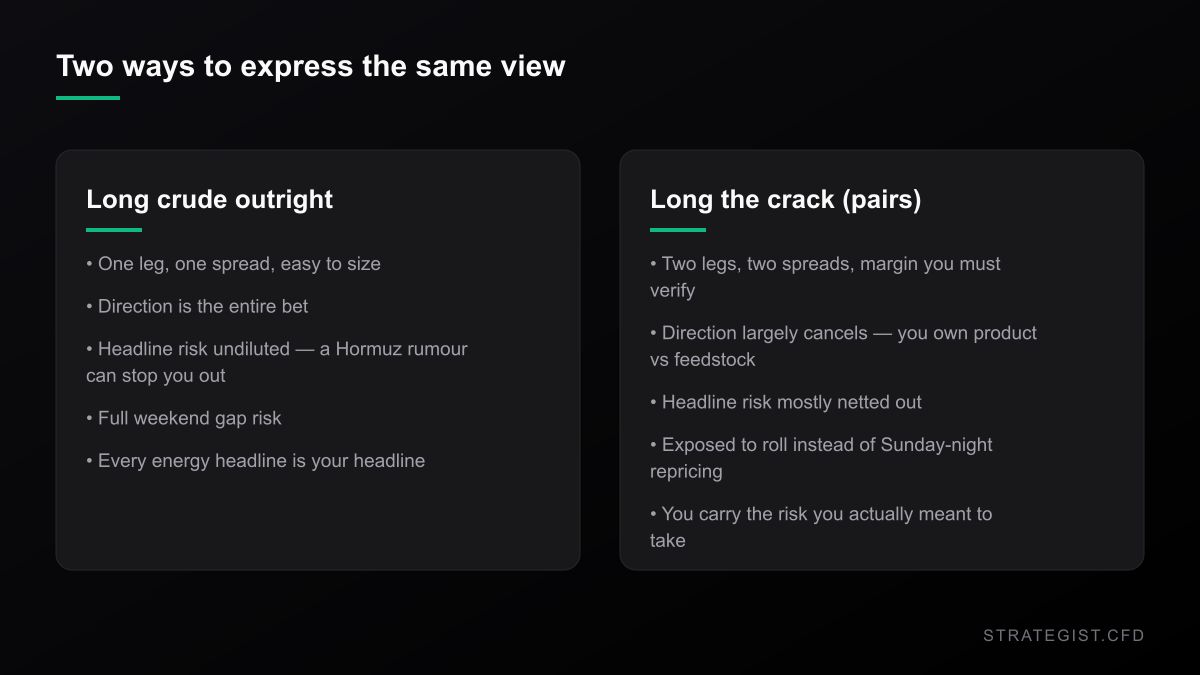
You cannot buy diesel at the pump as a trade. What a retail CFD broker will usually give you is gasoil or heating oil on the product side, and Brent or WTI on the crude side. Long one, short the other, sized so the dollar exposure is roughly matched rather than the contract count matched.
Three things bite you here, and none of them are obvious until after they have already bitten:
- Margin. You are opening two positions. Some brokers apply an offset on correlated energy pairs; most give you nothing close to full credit. Assume you are funding both legs until you have confirmed otherwise in writing.
- Financing. The long leg pays overnight swap. The short leg often pays too, because short borrow is not free either. With the 10-year Treasury touching 5% this week, a two-leg carry position you sit on for two months is paying a compounding tax on being early.
- Roll. Gasoil and Brent do not expire on the same day. Hold front months and you will roll one leg, then the other, and every roll is a spread you pay plus whatever the curve does while you are briefly exposed on only one side. Being right about the crack and still losing money to roll is a completely ordinary outcome.
Where this goes wrong
Here is the case against everything above, and it is a decent one.
Record margins are a mean-reverting series wearing a trend costume. Every crack that ever went to an extreme came back. But coming back is not a date, and record is not a trigger. The same record-low inventories that justify a $100 crack would also justify $120. Fundamentals this tight stay tight until a refinery returns, a war de-escalates, or demand genuinely breaks — and demand destruction arrives late, then arrives all at once.
There is a second problem, and it is specific to doing this as a retail CFD trader: your crack is synthetic. A refiner runs a physical operation with hedged feedstock, term contracts and months of inventory. Yours is two directional bets on two contracts, held together by the hope that the correlation stays put. It usually does. It does not hold on the days that matter, and on those days you discover your hedge was never a hedge. It was two positions.
Then there is the uncomfortable one. The equity market noticed this months ago — refiners have been repriced for record margins all year. If you are arriving here because you saw a headline about $6 diesel, you are late to the easy part and precisely on time for the hard part.
What to actually do with it
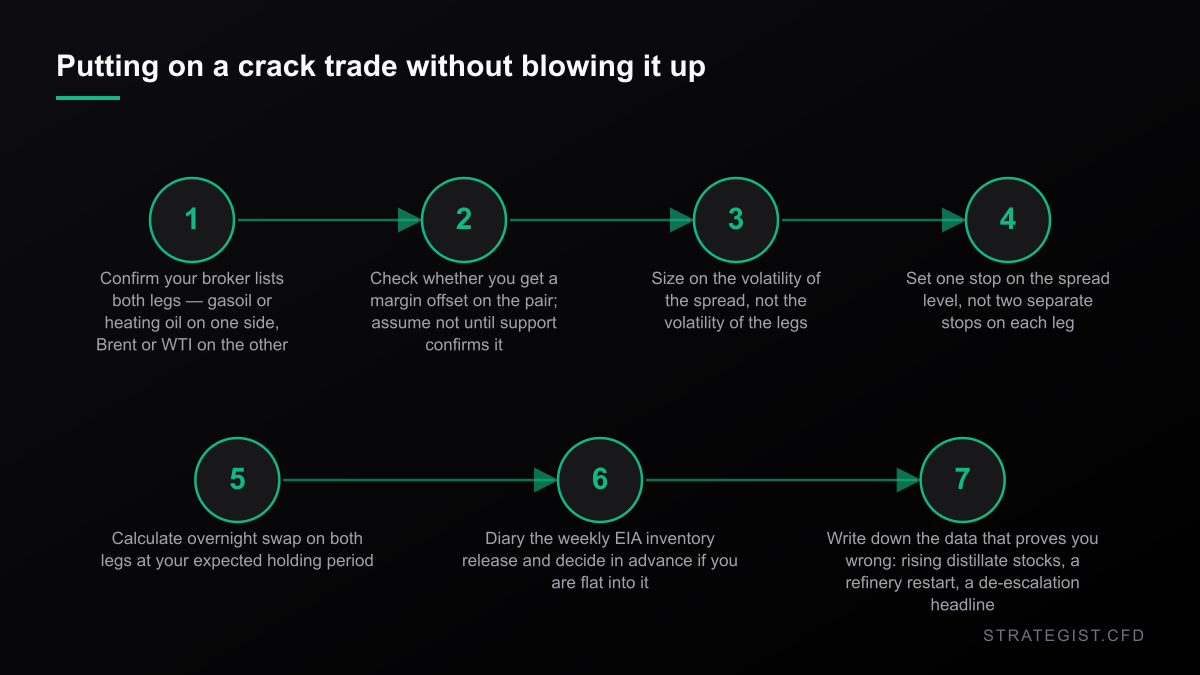
- Size on the spread, not the legs. The volatility of the crack is a fraction of the volatility of gasoil or Brent alone. Size off the legs and you will quietly be running a position several times larger than you think you are.
- Define the stop on the spread level. One number, on the difference. Not a stop on gasoil here and a stop on Brent there. If your platform cannot display the spread, you should not be running this trade on it.
- Know your EIA date. Weekly petroleum inventories land midweek and they move the product leg hard. Have a view on it or be flat into it. Do not be accidentally long a data print.
- Run the carry before you enter. Notional times swap rate times expected nights held. If that figure makes you flinch, the trade needs to be smaller or shorter.
- Pick the exit that is not a price. This trade ends when inventories stop falling, not when you hit a target. Decide in advance which data point would make you wrong.
Charts and analysis on this site are for research only and are not investment advice.
More in News
 News2026-09-19
Bitcoin Reclaimed $80,000 on a Rule Nobody Has Read
The CFTC's crypto filing reached the White House with no published text and no deadline. Bitcoin still jumped 5.9% on Friday. Here's what the filing says, what it doesn't, and how to size around it.
 News2026-09-18
Buffett Gave Up the Chair on Friday. Berkshire's Stock Shrugged — and That's the Tradeable Part
Warren Buffett quit the Berkshire chair after 56 years. The stock opened 0.4% lower and went nowhere. What a non-event actually tells CFD traders about sizing, gap risk and the index exposure you didn't choose.
 News2026-09-17
The SEC Cleared a Path to 24/7 Stock Trading. Gap Risk Just Moved.
The SEC's five-year Innovation Exemption lets venues trade tokenized U.S. stocks. The headline is 24/7 trading — but the halt rule buried in the order is what leveraged traders should be reading.