SpaceX's Nasdaq-100 Weight Doubles Friday. The Forced Bid Isn't Free Money.
What actually happens on Friday
SpaceX came public on June 12 at $135 a share and raised $75 billion doing it. Three and a half weeks later, on July 7, it was in the Nasdaq-100.
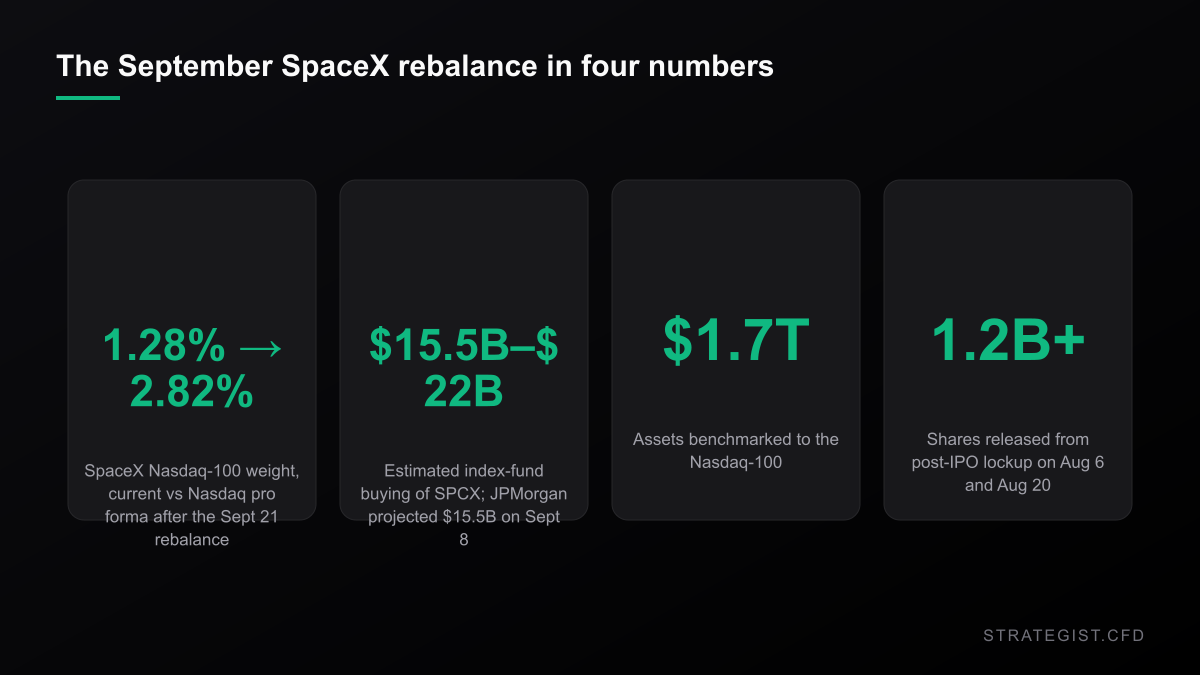
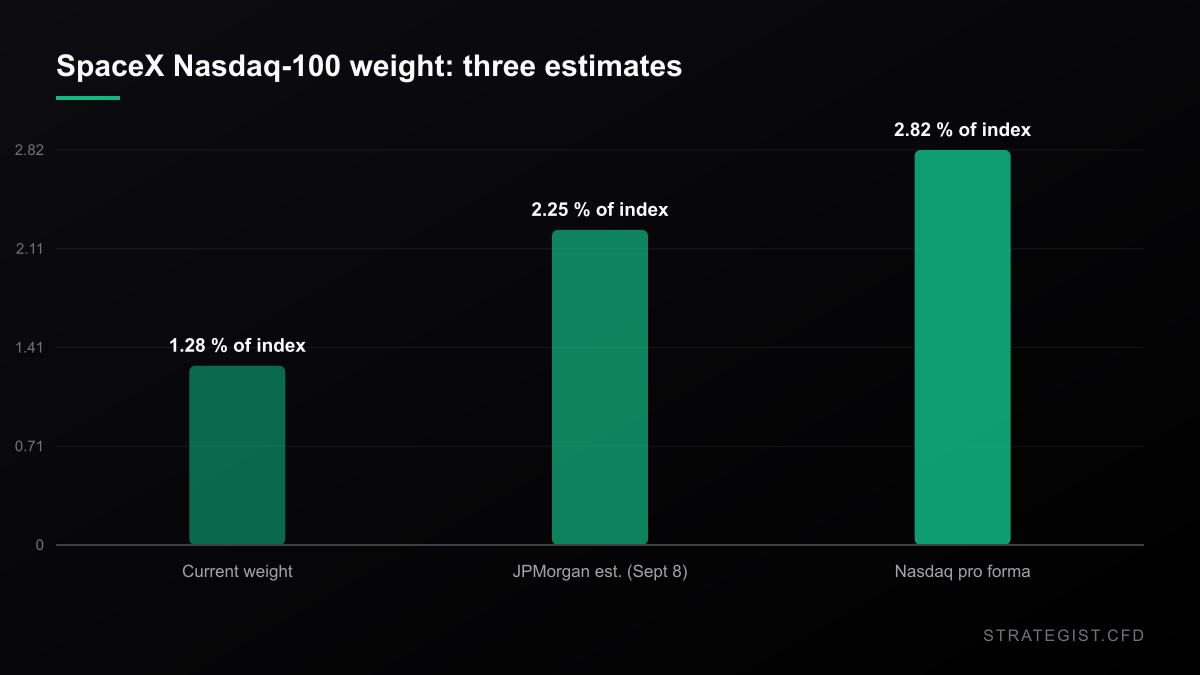
It entered as roughly the nineteenth-largest weight in the index at about 1.28%, which sounds wrong for a company valued near $2 trillion. The reason is a rule almost nobody reads: when a company's public float is below 33.3% of total shares, Nasdaq weights it on three times its freely tradable float rather than its full market cap. Right after the IPO, SpaceX's float was under 10%. The index was pricing a $2 trillion company as a fraction of itself, because on paper that's what was available.
Then the lockups started expiring. Aug 6 and Aug 20 together released more than 1.2 billion shares, and the big venture holders largely held on rather than dumping them, so tradable supply expanded without a wave of secondary selling. Free float has gone from under 10% to close to 30%. Nasdaq's own pro forma Global Index Watch data, reported by Bloomberg last week, now points to about 2.82% once the rebalance takes effect. More than double — and well above the 2.25% that JPMorgan's Min Moon team estimated on Sept 8.
Roughly $1.7 trillion is benchmarked to the Nasdaq-100. Funds tracking it have to buy somewhere between $15.5 billion and $22 billion of SPCX, and most of that gets worked into the closing cross on Friday, Sept 18. New weights take effect Monday, Sept 21.
The July 7 precedent is the whole trade
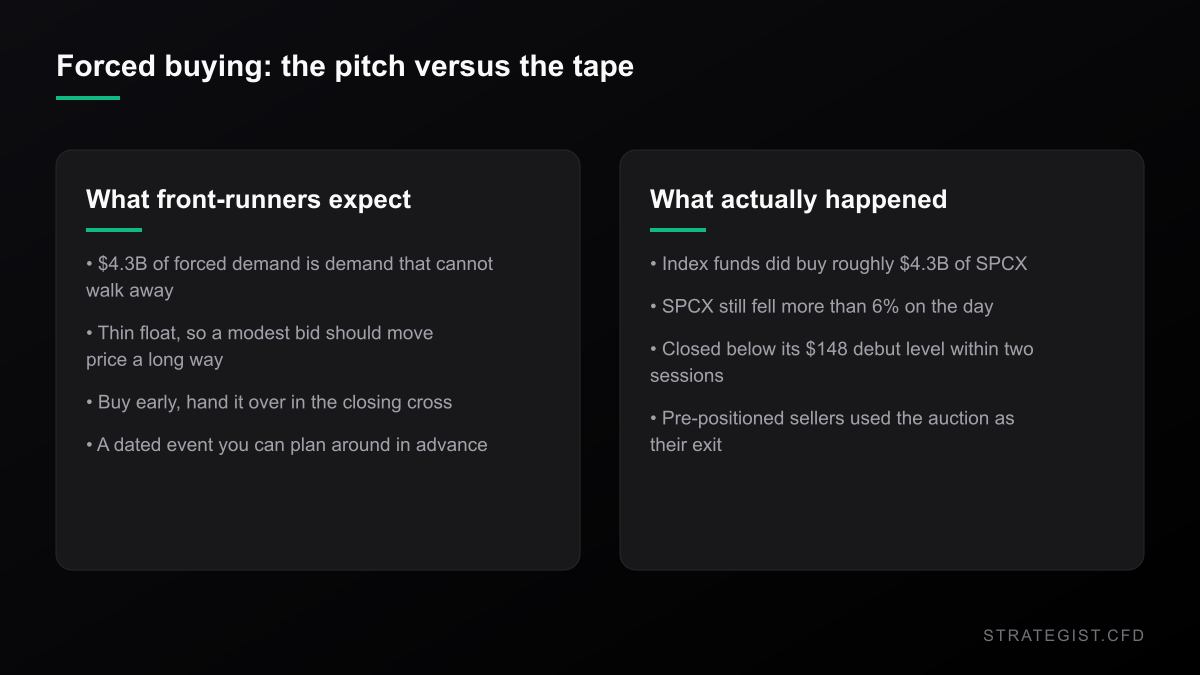
We have already run this experiment. When SpaceX joined the index, passive money absorbed an estimated $4.3 billion of forced buying. The stock fell more than 6% that session, and closed below its $148 debut level within two days.
That isn't a contradiction, and understanding why is most of the value here. Forced buying only pays if it's a surprise. Index rebalances are the opposite of a surprise — the date is published, the mechanics are public, and half a dozen banks publish size estimates in the week before. Everyone who wants to sell into that bid knows exactly when to show up. Liquidity providers accumulate in advance and hand their inventory over in the auction. The index fund gets filled. The front-runner gets to exit into the only deep liquidity of the day.
It's a transfer, not a gift. The only open question is which side of it you're standing on.
A bigger float cuts both ways
Here's the part that gets skipped in most coverage: the weight is going up because supply is going up. That 1.28% was never a market judgment about SpaceX. It was a float constraint. What changed is that more than 1.2 billion shares became sellable.
So the rebalance creates demand on a known date and supply on an open-ended one. And there's more supply scheduled: more than 2.3 billion restricted shares come out of lockup across late October and mid-November, right after third-quarter results. Buy SPCX on Friday because of index flow and you're buying into the first of at least three supply waves, not the last.
None of this makes SpaceX a bad business. Second-quarter revenue was $7.81 billion, up 91.9% year over year, and the nine-cent per-share loss came in well ahead of the 26-cent loss analysts had modeled. But the stock trades at roughly 106 times sales on about $18.67 billion of annualized revenue, and the 10-year Treasury printed a 19-year high this week. Story-driven assets at 106x sales don't get much benefit of the doubt when the discount rate is moving.
If you are long NAS100, you do not get a vote
This is the section that matters if you never touch the single name.
An index CFD is a wrapper. When Nasdaq changes the weights, your wrapper changes with it — you are being bought into SpaceX at whatever price the closing cross prints. There is no limit order in an index rebalance. You participate at the auction price or you don't participate.
At around 2.82%, that's a meaningful slice of your NAS100 or US100 exposure landing in one name, in one session, on a mechanical instruction you issued months ago by holding the position. If you were already running leveraged long index exposure into a week where the 10-year just made a 19-year high, this isn't the week to be handed more duration you didn't ask for.
Then check your book for double counting. Tesla slid 8.9% in the three months after the SpaceX IPO. Long a TSLA CFD and long a NAS100 CFD and you now hold Musk exposure twice — once deliberately, once by index arithmetic — and the second one gets bigger on Friday. Correlations you didn't plan for are the ones that actually hurt.
And price the carry. With short rates where they are, financing a leveraged long through an event you have no view on is a pure expense with no upside attached to it.
How to handle a scheduled flow
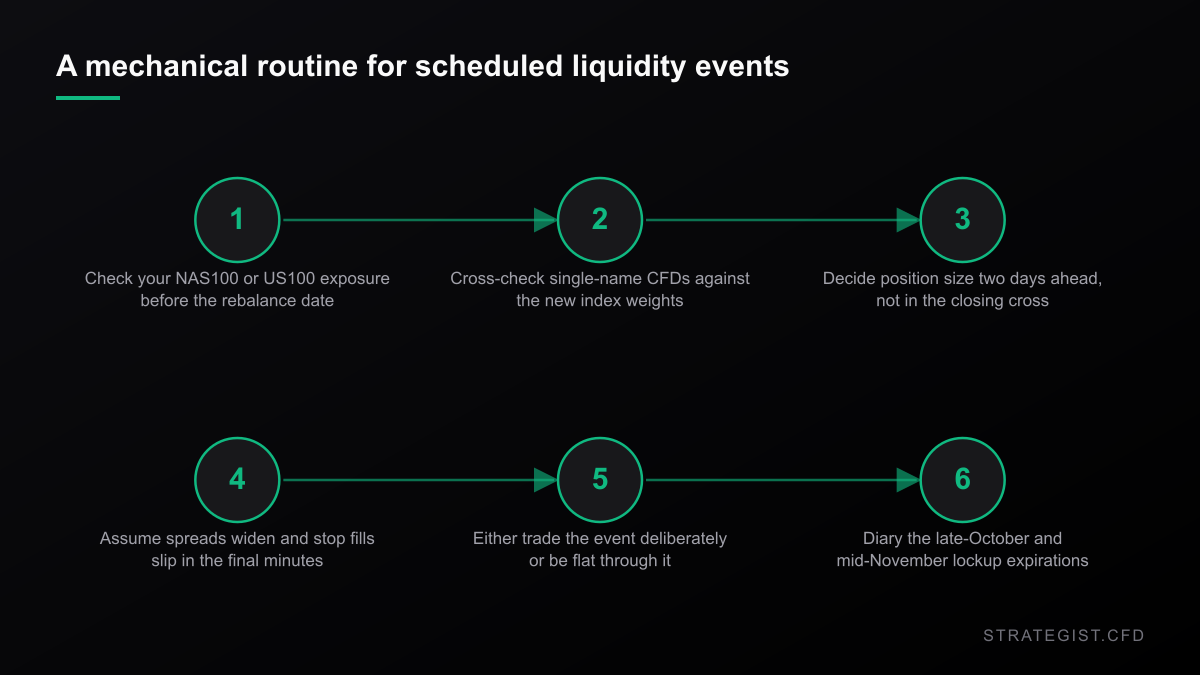
Scheduled liquidity events are one of the few places in markets where retail traders have genuinely complete information. The date is known, the direction is known, the rough size is known. That's exactly what makes them dangerous — complete information makes people feel safe, and feeling safe makes people size up.
The discipline isn't clever. It's mechanical, and it's the same every time.
Where this view is wrong
“It's already priced in” is the laziest sentence in finance, and I just leaned on it, so here's the case against me.
First: Nasdaq's own pro forma figure came in at 2.82% against a published sell-side estimate of 2.25%. That's a real upside surprise on the size of the flow, and size surprises do move prices. If the buying lands near the top of the $15.5–22 billion range rather than the bottom, Friday's auction could be genuinely one-sided.
Second: SPCX has been stuck in a $146–152 corridor. Corridors break. If it clears the top on rebalance day, momentum money arrives for reasons that have nothing to do with index mechanics, and the rebalance becomes the excuse rather than the cause. My read is patience, but I'm describing a distribution of outcomes, not stating a fact.
Third, and least comfortable: the float argument cuts my way in theory and may not in practice. The holders released in August largely didn't sell. If the same holds in October and November, then “more supply” is supply nobody uses, and the bearish leg of my argument quietly evaporates. I don't know that. Nobody does.
What to actually do with it
- Find out your index weight before Friday. If your platform publishes NAS100 constituent weights, look them up. If it doesn't, assume you're getting more SpaceX than you had on Monday.
- Cross-check your singles against the index. TSLA plus NAS100 is now a doubled bet. So is anything else you hold that's already a top-ten weight.
- Decide size on Wednesday, not Friday afternoon. The closing cross is the worst possible moment to be making decisions — widest spreads, worst fills, least time.
- Either trade the event or don't hold through it. Carrying a full-size position through a rebalance you have no view on is the one choice that is wrong from every angle.
- Diary the unlocks. More than 2.3 billion shares come free across late October and mid-November. That's the real supply test, and it's the one nobody is front-running yet.
Charts and analysis on this site are for research only and are not investment advice.
More in News
 News2026-09-19
Bitcoin Reclaimed $80,000 on a Rule Nobody Has Read
The CFTC's crypto filing reached the White House with no published text and no deadline. Bitcoin still jumped 5.9% on Friday. Here's what the filing says, what it doesn't, and how to size around it.
 News2026-09-18
Buffett Gave Up the Chair on Friday. Berkshire's Stock Shrugged — and That's the Tradeable Part
Warren Buffett quit the Berkshire chair after 56 years. The stock opened 0.4% lower and went nowhere. What a non-event actually tells CFD traders about sizing, gap risk and the index exposure you didn't choose.
 News2026-09-17
The SEC Cleared a Path to 24/7 Stock Trading. Gap Risk Just Moved.
The SEC's five-year Innovation Exemption lets venues trade tokenized U.S. stocks. The headline is 24/7 trading — but the halt rule buried in the order is what leveraged traders should be reading.